
Critical analysis of heterogeneous Earth observation networks for quantum-enabled climate monitoring
Priyank
Dubey
Texas A&M University
Poster
Fast-evolving climate and weather phenomena such as flash floods, coastal surges, and wildfires demand simultaneous, multi-modal, and continuous observations. A context-aware network of heterogeneous sensors with autonomous decision-making is required to detect, characterize, and track high-impact Earth system events through joint, time-correlated multi-sensor observations.
Two fundamental questions arise in designing such an architecture. First, as the network scales, the joint scheduling decision space grows combinatorically, rendering classical optimization intractable. Second, and more central to this work, is the question of physical feasibility: how can a fleet of heterogeneous sensors act as one coherent instrument with sufficient speed and reliability to capture the same event state within the event's decorrelation window?
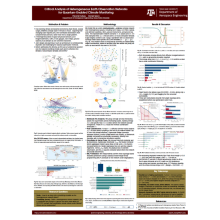
We address the feasibility question through a rigorous critical analysis that precedes any scheduling or algorithmic consideration. We model a representative system as a complex interacting network of space and ground assets, including GEO communication relay nodes, LEO SAR satellites, optical imagers, radar altimeters, thermal sensors, stratospheric UAVs, ground-based instruments, and antenna stations. Assets interact based on orbital geometry, line-of-sight windows, communication range, and co-observability strength, with edge weights encoding both inter-asset communication capacity and the scientific synergy generated when two sensors observe the same event within a prescribed time-window.
We analyze this joint communication-and-science graph using the Laplacian Renormalization Group (LRG), a formalism rooted in quantum statistical mechanics, to extract intrinsic coordination timescales, functional hierarchy, and structural vulnerabilities. Percolation analysis on the same network characterizes failure sensitivity and communication reliability under link degradation and asset loss. Together, these can yield hard feasibility bounds on co-observation, criticality rankings, and automatic asset role classifications into hubs, bridges, and bottlenecks, derived purely from network topology. The LRG-derived hierarchical decomposition reduces the full scheduling problem to a compact QUBO/Ising-mapped graph Hamiltonian of a size tractable on near-term NISQ devices, enabling topology-aware QAOA and quantum annealing as a concrete pathway for quantum-accelerated autonomous decision-making as constellation scale grows beyond classical solver capacity.
Two fundamental questions arise in designing such an architecture. First, as the network scales, the joint scheduling decision space grows combinatorically, rendering classical optimization intractable. Second, and more central to this work, is the question of physical feasibility: how can a fleet of heterogeneous sensors act as one coherent instrument with sufficient speed and reliability to capture the same event state within the event's decorrelation window?
We address the feasibility question through a rigorous critical analysis that precedes any scheduling or algorithmic consideration. We model a representative system as a complex interacting network of space and ground assets, including GEO communication relay nodes, LEO SAR satellites, optical imagers, radar altimeters, thermal sensors, stratospheric UAVs, ground-based instruments, and antenna stations. Assets interact based on orbital geometry, line-of-sight windows, communication range, and co-observability strength, with edge weights encoding both inter-asset communication capacity and the scientific synergy generated when two sensors observe the same event within a prescribed time-window.
We analyze this joint communication-and-science graph using the Laplacian Renormalization Group (LRG), a formalism rooted in quantum statistical mechanics, to extract intrinsic coordination timescales, functional hierarchy, and structural vulnerabilities. Percolation analysis on the same network characterizes failure sensitivity and communication reliability under link degradation and asset loss. Together, these can yield hard feasibility bounds on co-observation, criticality rankings, and automatic asset role classifications into hubs, bridges, and bottlenecks, derived purely from network topology. The LRG-derived hierarchical decomposition reduces the full scheduling problem to a compact QUBO/Ising-mapped graph Hamiltonian of a size tractable on near-term NISQ devices, enabling topology-aware QAOA and quantum annealing as a concrete pathway for quantum-accelerated autonomous decision-making as constellation scale grows beyond classical solver capacity.
dubey-priyank-quantum.pdf
(14.14 MB)