
Quantum mechanics for large-eddy parameterizations
David
Freeman
Dartmouth College
Poster
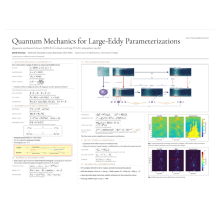
Quantum mechanics, viewed as a mathematical formalism, can be understood as a noncommutative generalization of classical probability theory. Quantum Mechanical Closure (QMCl) uses this perspective to develop data-driven parameterizations of dynamical systems: unresolved variables are represented by quantum states whose evolution is conditioned on the resolved dynamics. This provides a framework for embedding probabilistic information from high-dimensional classical systems into a quantum-mechanical structure.
In this talk, I will present recent results applying QMCl to cloud-microphysics parameterization in a coarse-grained Walker-cell simulation using the EULAG atmospheric model. I will describe the general QMCl framework, its role in representing unresolved atmospheric processes, and its performance in reproducing aspects of the fine-scale dynamics. I will also discuss how the mathematical structure of QMCl naturally suggests implementations on quantum circuits, and outline possible extensions toward quantum architectures for atmospheric parameterization.
In this talk, I will present recent results applying QMCl to cloud-microphysics parameterization in a coarse-grained Walker-cell simulation using the EULAG atmospheric model. I will describe the general QMCl framework, its role in representing unresolved atmospheric processes, and its performance in reproducing aspects of the fine-scale dynamics. I will also discuss how the mathematical structure of QMCl naturally suggests implementations on quantum circuits, and outline possible extensions toward quantum architectures for atmospheric parameterization.
freeman-david-quantum.pdf
(2.75 MB)