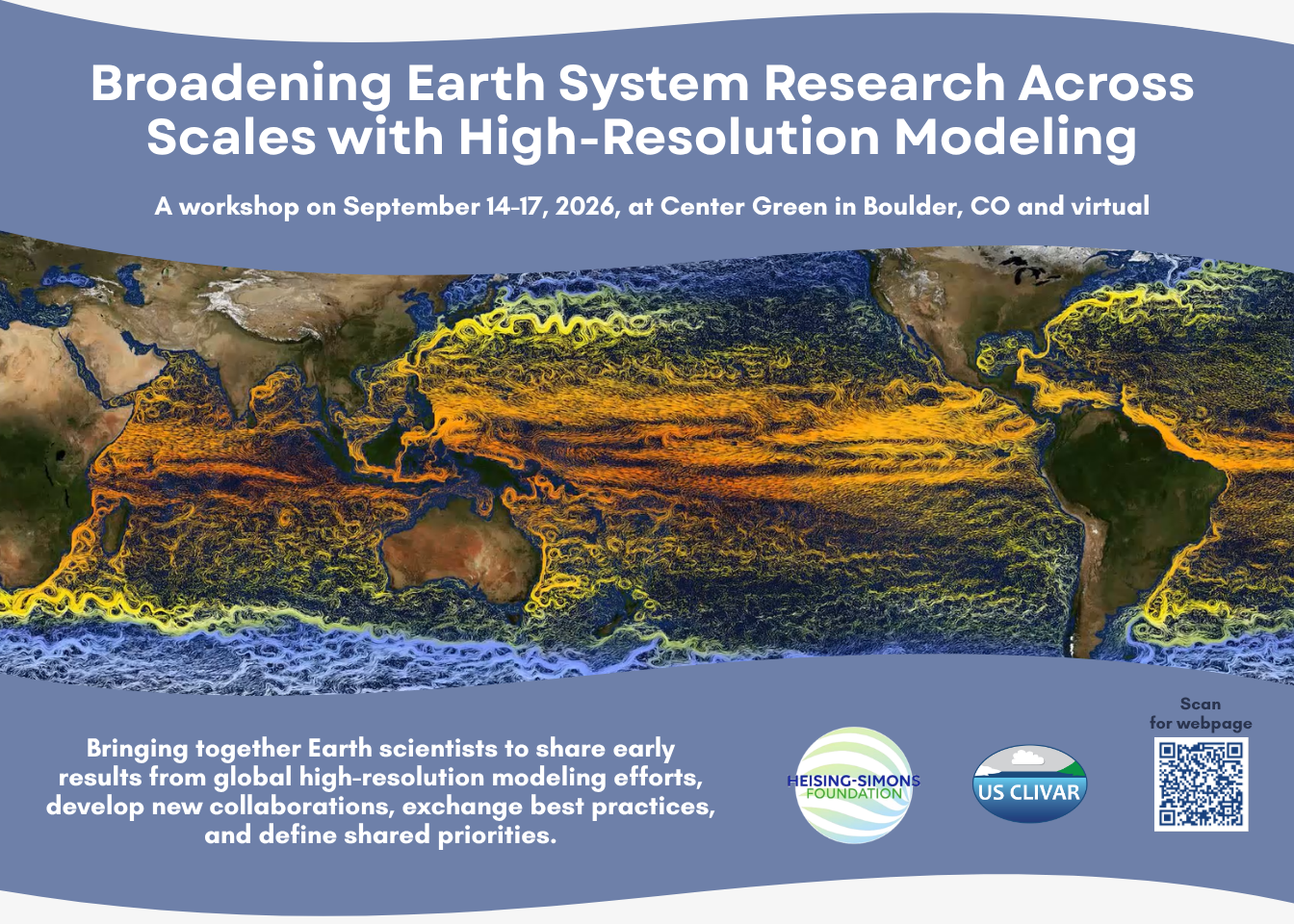

Broadening Earth System Research Across Scales with High-Resolution Modeling Workshop
Advances in climate modeling and computational power now allow models to run at increasingly fine spatial resolutions. At these scales, models can explicitly simulate processes that shape climate variability and extremes from local to global scales.
Location
The workshop will take place at the UCAR Center Green 1 (CG1) Building located at 3080 Center Green Drive, Boulder, CO 80301.
Objectives
Increasing climate model resolution has always required difficult tradeoffs between spatial detail, ensemble size, and simulation length. New modeling initiatives reaching ¼ degree resolution and beyond are allowing us to finally quantify these constraints more systematically and evaluate models in fundamental new ways.
In this workshop, we will examine early results from major high-resolution efforts—including MESACLIP, HighResMIP, and EERIE—as well as from individual model development groups such as ICON and E3SM. By bringing these communities together, we aim to exchange best practices, compare emerging results, and define shared priorities for the next generation of climate modeling.
The workshop will assess the scientific value of increasing model resolution for simulating global climate, regional processes, and extreme events. If clear benefits emerge, how should the community coordinate efforts to design new model hierarchies while navigating computational tradeoffs? What are the metrics for success of these new experiments (e.g. constraints on Equilibrium Climate Sensitivity, realistic tropical variability, skill in reproducing regional climate impacts, process-based understanding for low-resolution parameterization development)?
We will also explore how high-resolution models can expand into new applications, including paleoclimate simulations and regional downscaling. A key question is how to ensure that researchers around the world—particularly early career scientists and colleagues from the Global South—maintain access to next generation modeling resources and output.
By synthesizing emerging results, fostering new collaborations, and debating the costs and benefits of high-resolution ensembles, the workshop will help clarify the optimal balance between model resolution, ensemble size, and experimental breadth. The goal is to outline a community roadmap for advancing next-generation climate modeling over the coming decade.
Participants
Scientists across all fields within earth science with an interest in high resolution climate modeling are welcome to attend. We anticipate 100 in-person attendees and an unlimited number of virtual participants. We encourage and look forward to supporting early career researchers and researchers from the Global South. Registration for in-person participation is on a first-come, first-served basis until capacity is reached, and will open in late April. Abstract submissions will also open in April, and are not a requirement for participation.
Format
The 4-day meeting will be hybrid, with participants convening in person at the NCAR Mesa Lab in Boulder and online. The first 3 days will include plenary sessions with invited overview talks and contributed presentations, interactive poster sessions, in-depth plenary and breakout discussions, and a networking event. The last day will be a half day composed of practical sessions designed to foster new, global collaborations and pursue new applications and understanding of high resolution model output.
Outcomes
We aim to build and document new community best practices and priorities for the emerging field of high-resolution climate modeling. We will summarize these priorities in a report to formalize and disseminate these ideas in the community.
Scientific Organizing Committee
Pedro DiNezio, chair (University of Colorado Boulder)
Jeremy Klavans, co-chair (University of Miami)
Fred Castruccio, co-chair (NSF NCAR)
Ping Chang (Texas A&M University)
Gokhan Danabasoglu (NSF NCAR)
Clara Deser (NSF NCAR)
Dan Fu (Texas A&M University)
Robert Jnglin Wills (ETH Zurich)
Sophia Macarewich (NSF NCAR)
Bette Otto-Bliesner (NSF NCAR)
Andreas Prein (ETH Zurich)
Alexandra Ramos Valle (NSF NCAR)
Giovanni Seijo (University of Puerto Rico-Mayaguez)
Program Organizing Committee
Alyssa Johnson, US CLIVAR
Mike Patterson, US CLIVAR
Workshop Sponsors