
Quantum inspired approaches for simulations of differential equations
Ryan
Connor
University of Oxford
Poster
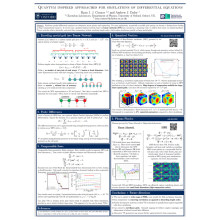
Non-linear partial differential equations are ubiquitous across physics and engineering, and govern for example the dynamics of fluids and plasmas . For some of these applications numerically accessible grid spacing can become a limiting factor leading to large computational resources, especially in describing turbulent dynamics and high dimensional systems. In recent years, quantum-inspired methods based on tensor networks have emerged as a promising route to address these issues on classical hardware. Tensor networks achieve physically motivated data compression without sacrificing length scales that makes simulations possible on large spatial grids which would be infeasible with direct numerical simulations. In this work, we present an overview of the application of tensor networks to simulations of compressible flows and plasma dynamics, outlining the advantage in the numerical scaling of these approaches as compared to conventional simulations methods. We find that tensor network approaches are particularly efficient for such dynamics and provides a path to simulate turbulent flows beyond that which state of the art direct simulations can currently achieve, and provide a route to future quantum algorithms.
connor-ryan-quantum.pdf
(11.25 MB)