
Who We Are
US CLIVAR is a national research program with a mission to foster understanding and prediction of climate variability and change on intraseasonal-to-centennial timescales, through observations and modeling with emphasis on the role of the ocean and its interaction with other elements of the Earth system, and to serve the climate community and society through the coordination and facilitation of research on outstanding climate questions.
Our Research
The ocean plays a key role in providing a major long-term "memory" for the climate system, generating or enhancing variability on a range of climatic timescales. Understanding the ocean's role in climate variability is therefore crucial for quantifying and harnessing the predictability inherent to the Earth system. US CLIVAR-led research has played a substantial role in advancing understanding of, and skill in predicting climate variability and change.
Science and Research Challenges
Subseasonal-to-
Seasonal Prediction

Decadal Variability
and Predictability
Climate Change
Climate and Extreme
Events

Polar Climate Changes

Climate and Marine
Carbon/Biogeochemistry

Climate at the Coasts
Announcements
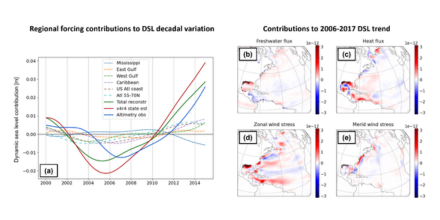
Quantifying the contributions of surface forcing to sea level variability along the US Gulf Coast
Delman et al. (2026) use an adjoint model from the observationally-constrained Estimating the Circulation and Climate of the Ocean (ECCO) state estimate to quantify surface atmospheric and hydrologic forcing to sea level.
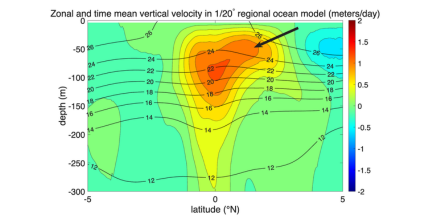
Ocean eddies structure mean equatorial upwelling
Whitt et al. (2026) use a high-resolution, eddy-resolving ocean model together with a novel method to demonstrate that eddies play a major role in shaping where water rises towards the surface on average.
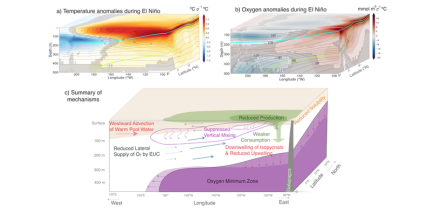
What explains the interannual variability of O2 content and distribution in the tropical Pacific?
Eddebbar et al. (2026) use observations-based and modeling products to discuss future changes in tropical Pacific O2.

Abstract Submission and Travel Requests are due on May 11, 2026
Abstract submissions and travel requests for the Quantum Computing and Sensing for Weather and Climate Applications workshop are being accepted through May 11, 2026.
Upcoming Webinars
Usable Climate Risk Science Webinar Series
Carolyn Kousky (Insurance for Good)
Ori Chegwidden (CarbonPlan)
During the fifth webinar in the Usable Climate Risk Science webinar series, we will be joined by Carolyn Kousky (Insurance for Good) who will discuss how we can create insurable communities. Ori Chegwidden (CarbonPlan) will discuss a new platform, Open Climate Risk, an explorer that maps wildfire risk across the contiguous United States.