
Coupled air-sea simulations reveal the dynamics of surface wave growth and breaking-induced dissipation
Ocean waves grow and eventually break under the action of strong winds, a process that plays a key role in the exchange of energy and momentum between the atmosphere and the ocean, particularly during extreme weather events such as winter storms and tropical cyclones. Yet the detailed physics governing the wave growth and breaking remains difficult to measure directly in the open ocean.
Scapin et al. (2026) use state-of-the-art, high-resolution computer simulations to recreate wind-driven waves under strong wind conditions. The simulations resolve both the turbulent air above the surface and the water motion below it, allowing tracking of the full cycle of wave growth and breaking from first principles.
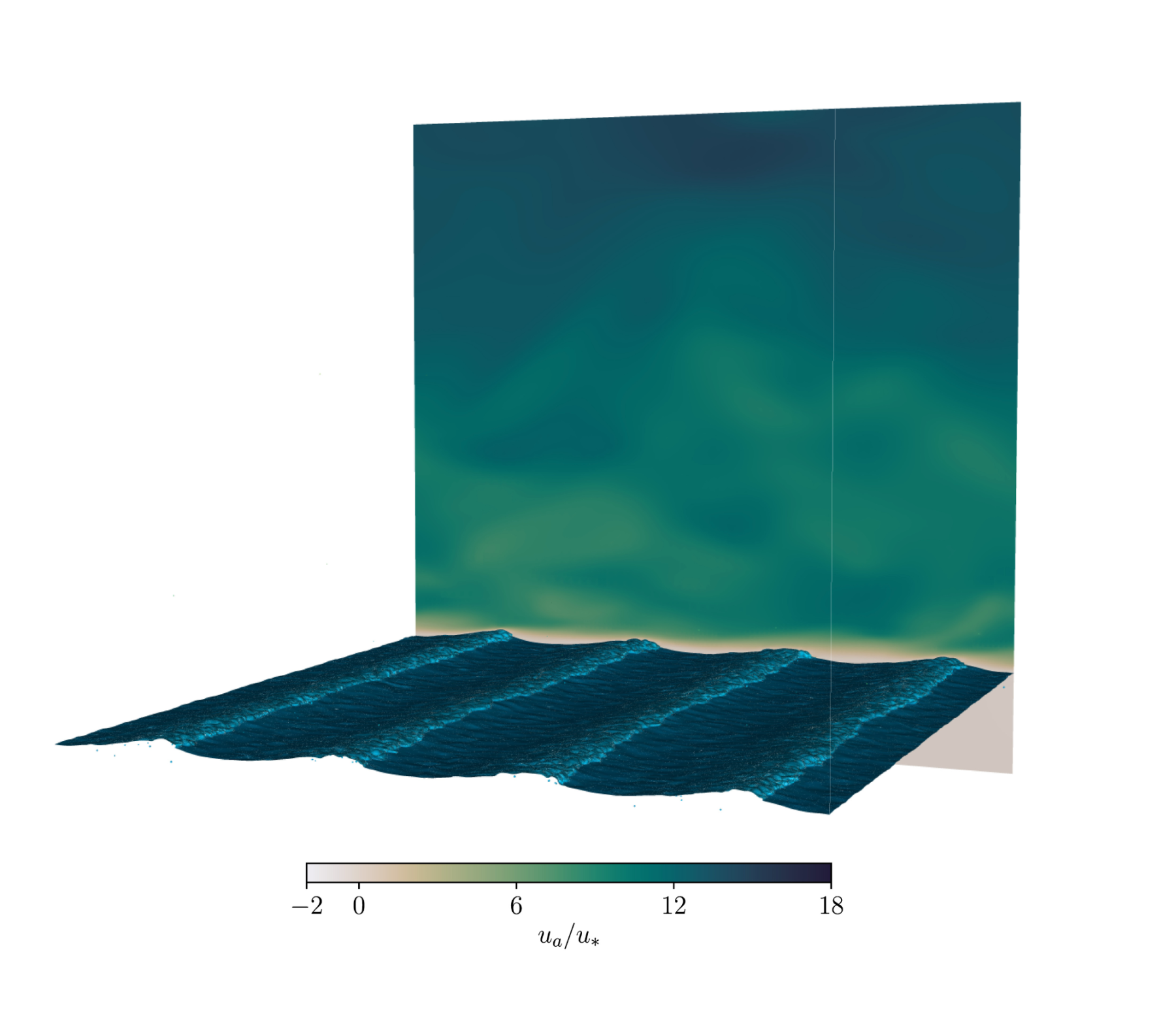
Turbulent wind blowing over a wave field. The panel on the right displays the wind velocity normalized by the wind friction velocity, with the colorbar at the bottom indicating its magnitude. The wave surface (in dark blue) is shown during the breaking stage.
The authors find that waves grow primarily due to pressure differences created by the turbulent wind over their surface. The rate at which waves grow depends not only on wind strength but also on wave steepness: steeper waves interact differently with the airflow, modifying how efficiently they extract energy from the wind. Once waves reach a critical steepness, they break. At that moment, the direction of energy transfer reverses: energy stored in the wave is rapidly injected into the water column, generating strong turbulence and currents beneath the surface.
A key result of the study is that the energy dissipated due to breaking is controlled by the strength of the breaking event, that is, the energy stored in the waves, and is not directly dependent on the instantaneous wind speed. This is also reflected in the vertical structure of the dissipated energy, which appears to be universal if properly re-scaled by the total energy dissipated due to breaking and agrees well with field measurements from the open ocean.
Together, these findings provide a better physical framework for understanding air–sea energy exchange, helping to improve models used in weather forecasting and climate prediction.
Scapin, N., J. Wu, J. T. Farrar, B. Chapron, S. Popinet, and L. Deike, 2026: Growth rate and energy dissipation in wind‐forced breaking waves. Geophys. Res. Lett., 53, e2025GL117901, https://doi.org/10.1029/2025GL117901.
Topics
- Air-Sea
- Extreme Events
- Modeling
- Weather