
Future changes of the Kuroshio and the Kuroshio Extension in eddy-resolving climate models
Yukito
Tamura
The University of Tokyo
Poster
Satellite observations reveal poleward shifts of major subtropical western boundary currents (WBCs) in recent decades, and these trends are driven by poleward shifts of atmospheric westerly jet. However, the observed trends may contain strong decadal or interdecadal natural variability. On the other hand, conventional climate models, such as Coupled Model Intercomparison Project (CMIP) models, are spatially too coarse to adequately resolve WBCs. Additionally, future projections by CMIP models contain large uncertainty in the Northern Hemisphere, compared to the Southern Hemisphere. Therefore, it is important to investigate future changes in WBCs using eddy-resolving climate models.
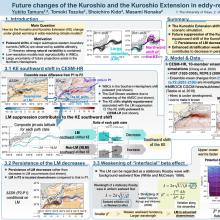
In this study, future changes of WBCs are examined using products from MESACLIP, including 10-member ensemble historical (HIST) and Representative Concentration Pathway 8.5 (RCP8.5) simulations conducted with CESM-HR and CESM-LR. In CESM-HR, although WBCs and the westerly jet coherently shift poleward in the Southern Hemisphere, the Kuroshio and the Gulf Stream in the Northern Hemisphere exhibit different responses. The Gulf Stream is projected to weaken under global warming, likely due to slowdown of the Atlantic Meridional Overturning Circulation. Notably, the Kuroshio Extension (KE) migrates slightly equatorward, accompanied by suppression of the Kuroshio large meander (LM) south of Japan. In CESM-HR, the KE tends to occupy a more northerly (southerly) position when the Kuroshio follows the LM (non-LM) path. Hence, the reduction in the Kuroshio LM occurrence contributes to the equatorward shift of the KE. In CESM-LR, by contrast, the KE shifts poleward likely because the low-resolution model cannot represent the Kuroshio LM and its future suppression. Additionally, results from newly developed MIROC6 coupled with an eddy-resolving ocean model will be introduced and compared with those from CESM-HR in the presentation.
In this study, future changes of WBCs are examined using products from MESACLIP, including 10-member ensemble historical (HIST) and Representative Concentration Pathway 8.5 (RCP8.5) simulations conducted with CESM-HR and CESM-LR. In CESM-HR, although WBCs and the westerly jet coherently shift poleward in the Southern Hemisphere, the Kuroshio and the Gulf Stream in the Northern Hemisphere exhibit different responses. The Gulf Stream is projected to weaken under global warming, likely due to slowdown of the Atlantic Meridional Overturning Circulation. Notably, the Kuroshio Extension (KE) migrates slightly equatorward, accompanied by suppression of the Kuroshio large meander (LM) south of Japan. In CESM-HR, the KE tends to occupy a more northerly (southerly) position when the Kuroshio follows the LM (non-LM) path. Hence, the reduction in the Kuroshio LM occurrence contributes to the equatorward shift of the KE. In CESM-LR, by contrast, the KE shifts poleward likely because the low-resolution model cannot represent the Kuroshio LM and its future suppression. Additionally, results from newly developed MIROC6 coupled with an eddy-resolving ocean model will be introduced and compared with those from CESM-HR in the presentation.
Poster file
tamura-yukito-highres.pdf
(4.81 MB)