
High resolution coupled simulations for the Northern Adriatic Region
Marco
Reale
National Institute of Oceanography and Applied Geophysics-OGS
Poster
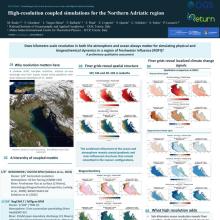
Located in the Northern-Eastern part of the Mediterranean region, the Northern Adriatic area is widely recognized as a severe convective outbreak zone and is characterized by the presence of steep orographic features (the Alpine and Apennines chains) enclosing the relatively flat area of the Po Valley. Moreover, the region hosts the Northern Adriatic Sea, which is a shallow semi-enclosed basin whose dynamics is significantly shaped by riverine inputs and strong air–sea interactions that, in turn, drives deep water formation processes and a strong coupling between physics and marine ecosystems.
Here we introduce two high-resolution modeling systems that have been used to produce climate datasets for the region: (i) the Regional Earth System Model RegCM-ES and (ii) the ocean-biogeochemical model MITgcm-BFM. The former is composed by: (i) atmospheric model RegCM5 (in convection-permitting configuration with an horizontal resolution of 3 km and 41 vertical levels, Coppola et al., 2025), (ii) the MITgcm ocean (in non-hydrostatic configuration with an horizontal resolution of approximately 700 m and 59 vertical levels, Marshall et al., 1997a,b), (iii) the river discharge model CHyM with an horizontal resolution of approximately 1 km (Coppola et al., 2007), and (iv) the biogeochemical model BFM (Vichi et al., 2025). The latter is composed by the ocean model MITgcm (non-hydrostatic configuration with an horizontal resolution of approximately 700 m and 27 vertical levels), and again the biogeochemical model BFM.
By using both modeling tools and, as initial and boundary conditions, state-of-the-art atmospheric and ocean reanalysis (ERA5 and Copernicus Marine Service) and CMIP5 (HadGEM-ES) and CMIP6 (EC-Earth3-Veg) GCM under emission scenario SSP3-7.0 and RCP8.5 respectively, we produced first-of-its-kind high-resolution datasets for the physics and biogeochemistry of the region. Preliminary analysis shows that the coupling between ocean and atmosphere affects the simulation of the hydrological regime in the region with a strength that decreases with the distance from the area where the coupling is active. Moreover, under different emissions scenarios, simulations projects a significant warming of the Northern Adriatic Sea (in particular of its coastal areas) as well as a decrease of the oxygen content, of pH and a decline in the phosphate content of the euphotic layer of the basin.
Overall, these new modeling systems have shown to be a suitable tool for simulating at an unprecedented spatial resolution the climate dynamics of the Northern Adriatic region, and are currently employed to produce climate projections, also in the frame of the EU-Horizon RIVIERADE project.
Here we introduce two high-resolution modeling systems that have been used to produce climate datasets for the region: (i) the Regional Earth System Model RegCM-ES and (ii) the ocean-biogeochemical model MITgcm-BFM. The former is composed by: (i) atmospheric model RegCM5 (in convection-permitting configuration with an horizontal resolution of 3 km and 41 vertical levels, Coppola et al., 2025), (ii) the MITgcm ocean (in non-hydrostatic configuration with an horizontal resolution of approximately 700 m and 59 vertical levels, Marshall et al., 1997a,b), (iii) the river discharge model CHyM with an horizontal resolution of approximately 1 km (Coppola et al., 2007), and (iv) the biogeochemical model BFM (Vichi et al., 2025). The latter is composed by the ocean model MITgcm (non-hydrostatic configuration with an horizontal resolution of approximately 700 m and 27 vertical levels), and again the biogeochemical model BFM.
By using both modeling tools and, as initial and boundary conditions, state-of-the-art atmospheric and ocean reanalysis (ERA5 and Copernicus Marine Service) and CMIP5 (HadGEM-ES) and CMIP6 (EC-Earth3-Veg) GCM under emission scenario SSP3-7.0 and RCP8.5 respectively, we produced first-of-its-kind high-resolution datasets for the physics and biogeochemistry of the region. Preliminary analysis shows that the coupling between ocean and atmosphere affects the simulation of the hydrological regime in the region with a strength that decreases with the distance from the area where the coupling is active. Moreover, under different emissions scenarios, simulations projects a significant warming of the Northern Adriatic Sea (in particular of its coastal areas) as well as a decrease of the oxygen content, of pH and a decline in the phosphate content of the euphotic layer of the basin.
Overall, these new modeling systems have shown to be a suitable tool for simulating at an unprecedented spatial resolution the climate dynamics of the Northern Adriatic region, and are currently employed to produce climate projections, also in the frame of the EU-Horizon RIVIERADE project.
Poster file
Reale-Marco-highres.pdf
(4.5 MB)