
Increasing model resolution fails to improve the simulation of trends in the North Atlantic jet and its impacts
Jacqueline
Kiszka
University of Miami, Rosenstiel School of Marine, Atmospheric, and Earth Science
Poster
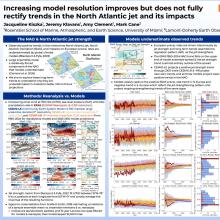
Lengthening observational records are producing trends that global climate models fail to capture, including positive trends in the North Atlantic Oscillation (NAO), the wintertime North Atlantic jet, and their impacts on European and East African precipitation. Models’ underestimation of these real-world trends in North Atlantic climate patterns implies that external forcing signals may be interacting with natural variability. In this study, we examine trends during the observational period (1950–2025) and future model projections (2025–2100) of the NAO index, North Atlantic jet strength, and European precipitation in the ECMWF Reanalysis v5 (ERA5) and the Community Earth System Model version 2 large ensemble (CESM2-LE) and version 1 high resolution (MESACLIP CESM1-HR). The positive NAO trend in ERA5 falls in the upper range of the ensemble spread of CESM2-LE and CESM1-HR, and both models show small positive trends in the NAO index through 2100. The positive jet strength trend and eastward jet shift in ERA5 are nearly entirely missed in both the standard and high resolution models, with virtually no trend in jet strength projected through 2100. Increasing model resolution does not improve precipitation trends, with both CESM2-LE and CESM1-HR failing to capture observed 1950–2025 trends of increasing precipitation over Northern Europe and decreasing precipitation over Southern Europe. We aim to better understand why these trends are not well-captured in both standard- and high-resolution models, allowing us to examine the role of internal climate variability versus forced signals in the North Atlantic, evaluate global climate models, and ultimately improve our confidence in future climate projections.
Poster file
kiszka-jacqueline-hires.pdf
(1.94 MB)