
Scale-Dependent Coupled Boundary Layer Energetics: New Metrics for km-Scale Model Evaluation and Parameterization
Momme
Hell
WHOI
Poster
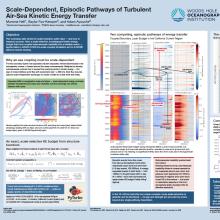
Kilometer-scale coupled climate models are beginning to resolve processes that fundamentally alter how energy is exchanged between the ocean and atmosphere—but we currently lack diagnostic frameworks capable of evaluating whether these models get the right physics for the right reasons. Here, we present a structure-function-based analysis of scale-dependent kinetic energy budgets in the coupled boundary layer and apply it to km-scale COAS simulations of the California Current System. We identify two coexisting routes of cross-interface energy transfer: (1) synoptic-scale atmospheric events drive mesoscale wind-work on the ocean and forward cascades to smaller scales in both fluids; (2) ocean submesoscale instabilities generate inverse (upscale) energy cascades and induce their own wind- and pressure-work responses. These competing up- and downscale cascades coexist in both fluids' Boundary layers but are are overlooked in bulk flux formulations based on homogeneous similarity theory. Comparison with airborne Doppler scatterometer observations from the S-MODE field campaign validates the scale-dependent variability seen in the model and demonstrates that remote sensing can constrain these cross-scale energy transfers. This framework provides process-based metrics for evaluating km-scale coupled models—particularly the scale at which energy exchange transitions from synoptic-forced to submesoscale-driven regimes—and offers a path toward scale-aware, stochastic air-sea flux parameterizations for use in coarser-resolution climate models. We discuss implications for high-resolution model hierarchy design and how resolving coupled boundary-layer turbulence changes estimates of near-surface energy budgets relevant to climate sensitivity.
Poster file
Hell-Momme_high_res.pdf
(1.72 MB)