
Too weak decadal variability of the Northern Hemisphere eddy-driven jets remains at high-resolution in CESM1
Robert
Jnglin Wills
ETH Zurich
Poster
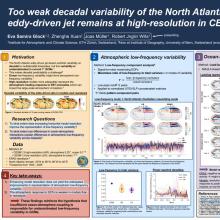
Decadal to multi-decadal modulations of the northern wintertime eddy-driven jet streams impact weather and societies in Europe and North America. However, the current generation of 1° coupled climate models shows notably weaker low-frequency atmospheric variability than is observed in reanalysis. This represents a challenge for decadal prediction. While mechanisms inducing atmospheric low-frequency variability remain debated, forcing from the extratropical oceans is a likely driver. High-resolution models have been shown to improve ocean-atmosphere coupling and, thus, might improve the representation of low-frequency atmospheric variability. Here, we employ low-frequency component analysis to determine leading modes of decadal atmospheric variability over the North Atlantic and the North Pacific in climate models and reanalysis. The identified dominant modes of low-frequency variability are spatially similar to the North Atlantic Oscillation and Aleutian Low variability, respectively. Comparing these modes between high- and low-resolution CESM1 ensembles and the ERA5 reanalysis reveals that the ratios of low-frequency to total variance are too small in CESM1 compared to reanalysis. For the North Pacific domain, the high-resolution simulations better reproduce this variance ratio. Yet, there are indications that this may be due to overly strong low-frequency variability associated with the El Niño-Southern Oscillation (ENSO) rather than an improved representation of physical mechanisms. Therefore, we find that increasing model resolution does not yield the anticipated gains in the representation of atmospheric low-frequency variability. Upon removal of the influence of ENSO, lead-lag regressions with sea surface temperatures reveal a potential role of the North Atlantic and the North Pacific oceans in driving atmospheric low-frequency variability in the reanalysis. Similar leading ocean patterns are not found in the models. This reinforces that insufficient ocean-atmosphere coupling might be an origin of lacking low-frequency variability in climate models.
Poster file
Glock-Eva-hires.pdf
(1.89 MB)