
Tropical Cyclone Climatology and Response to Vertical Wind Shear in MESACLIP
Jacob
Carstens
University of North Dakota
Poster
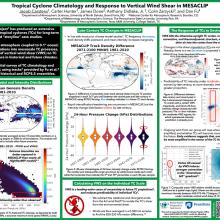
Mean tropical cyclone (TC) intensity is generally projected to increase as oceans warm, along with the proportion of TCs that become particularly intense. However, most TCs fail to reach their maximum potential intensity due to various internal and environmental factors. In particular, vertical wind shear (VWS) has long been considered an important negative influence on TC development. VWS tilts the otherwise-upright vortex, induces asymmetries in kinematic and thermodynamic structure, and can ventilate cooler, drier environmental air into the circulation. Sheared TCs have lower predictability, and uncertain projections of future large-scale VWS are a leading-order cause of spread in projected TC activity among climate models. Additionally, the mesoscale processes involved in the TC-VWS relationship have historically been difficult to simulate. Continued improvements in model resolution, however, are making this type of investigation more feasible.
In this study, we assess how TCs respond to their unique environmental VWS in MESACLIP. TCs are tracked objectively using TempestExtremes, and the global climatology of TC intensity, size, and geographic distribution is first explored under both historical and future climate scenarios. VWS is then calculated around the tracked TCs using two different techniques employed in operational statistical hurricane intensity models. We evaluate the historical global climatology of the VWS imparted on TCs, evaluating this against observational and reanalysis baselines. Finally, the relationship between VWS magnitude and subsequent intensity change, and the structural response of the TCs when encountering VWS, are explored. The MESACLIP dataset is decomposed into distinct 30-year climatologies to evaluate potential changes in the behavior of sheared TCs over time.
In this study, we assess how TCs respond to their unique environmental VWS in MESACLIP. TCs are tracked objectively using TempestExtremes, and the global climatology of TC intensity, size, and geographic distribution is first explored under both historical and future climate scenarios. VWS is then calculated around the tracked TCs using two different techniques employed in operational statistical hurricane intensity models. We evaluate the historical global climatology of the VWS imparted on TCs, evaluating this against observational and reanalysis baselines. Finally, the relationship between VWS magnitude and subsequent intensity change, and the structural response of the TCs when encountering VWS, are explored. The MESACLIP dataset is decomposed into distinct 30-year climatologies to evaluate potential changes in the behavior of sheared TCs over time.
Poster file
carstens-jacob-highres.pdf
(1.14 MB)