
Quantum algorithms for anistropic convection and diffusion equations
Julien
Zylberman
CERFACS
Poster
The simulation of fluid dynamics on quantum computers is a long-standing goal that has attracted significant attention in recent years. More broadly, the development of quantum numerical schemes for partial differential equations remains underdeveloped, and no scientific consensus has yet emerged regarding the potential for a quantum advantage.
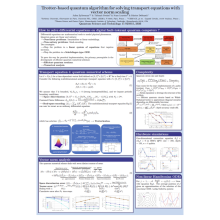
In this work, we adress the resolution of two fundamental PDEs: the anisotropic diffusion equation and the anisotropic convection equation. We present a quantum numerical scheme consisting of three steps: quantum state preparation, evolution with diagonal operators, and measurement of observables of interest. The evolution step relies on a high-order centered finite difference and a product formula approximation, also known as Trotterization. We provide novel vector-norm analysis to bound the different sources of error. We prove that the number of time-steps required in the evolution can be reduced by a factor Θ(16^n) for the diffusion equation, and Θ(4^n) for the convection equation, where n is the number of qubits per dimension, an exponential reduction compared to the previously established operator norm analysis. Detailed quantum circuits for each step are presented, along with classical simulations of the quantum numerical scheme that confirm the predicted resource scaling. Additionally, quantum hardware experiments are conducted on the simple one-dimensional convection equation, using up to 4 qubits and more than 500 elementary quantum gates.
This work paves the way for the development of more advanced quantum numerical schemes aimed at applications such as fluid simulation and weather forecasting.
In this work, we adress the resolution of two fundamental PDEs: the anisotropic diffusion equation and the anisotropic convection equation. We present a quantum numerical scheme consisting of three steps: quantum state preparation, evolution with diagonal operators, and measurement of observables of interest. The evolution step relies on a high-order centered finite difference and a product formula approximation, also known as Trotterization. We provide novel vector-norm analysis to bound the different sources of error. We prove that the number of time-steps required in the evolution can be reduced by a factor Θ(16^n) for the diffusion equation, and Θ(4^n) for the convection equation, where n is the number of qubits per dimension, an exponential reduction compared to the previously established operator norm analysis. Detailed quantum circuits for each step are presented, along with classical simulations of the quantum numerical scheme that confirm the predicted resource scaling. Additionally, quantum hardware experiments are conducted on the simple one-dimensional convection equation, using up to 4 qubits and more than 500 elementary quantum gates.
This work paves the way for the development of more advanced quantum numerical schemes aimed at applications such as fluid simulation and weather forecasting.
zylberman-poster.pdf
(5.55 MB)