
The dynamics of the Atlantic extratropical–tropical teleconnections
The Atlantic Meridional Overturning Circulation (AMOC) is a critical component of the climate system. Its weakening is associated with cooling in the North Atlantic and a southward displacement of the Atlantic Intertropical Convergence Zone (ITCZ), which governs rainfall patterns for millions of people in the tropics. The subpolar North Atlantic has been identified as a key region for predicting the ITCZ shift through the Atlantic extratropical-tropical teleconnection. Despite its significance, the mechanisms underlying this teleconnection and the influence of the extratropical North Atlantic on the boreal summer ITCZ remain poorly understood. The commonly used zonally symmetric energy budget framework, which emphasizes compensation between oceanic and atmospheric heat transport, does not fully explain the emergence of the zonally asymmetric North Atlantic sea surface temperature (SST) horseshoe pattern—characterized by a stronger response along the eastern boundary of the North Atlantic subtropical gyre—a defining feature of this teleconnection. Some previous studies attribute the equatorward propagation of cold extratropical SST anomalies to the positive wind-evaporation-SST feedback.
A recent study authored by Joshi and Zhang (2025) demonstrates that the wind-evaporation-SST feedback is not the dominant mechanism driving the Atlantic extratropical-tropical teleconnection during boreal summer. Instead, the southward advection of the upper extratropical North Atlantic signals by the North Atlantic subtropical gyre along a horseshoe-shaped pathway plays a central role in forming the characteristic cold SST horseshoe pattern. Furthermore, the AMOC weakening alters the upper tropical North Atlantic western boundary current, an effect amplified by enhanced surface wind stress curl over the tropical North Atlantic, contributing to warmer tropical Atlantic subsurface thermocline temperature and SST in the tropical South Atlantic. The resulting dipole Atlantic SST anomalies induce trade wind adjustments, ultimately the southward ITCZ shift over the tropical Atlantic.
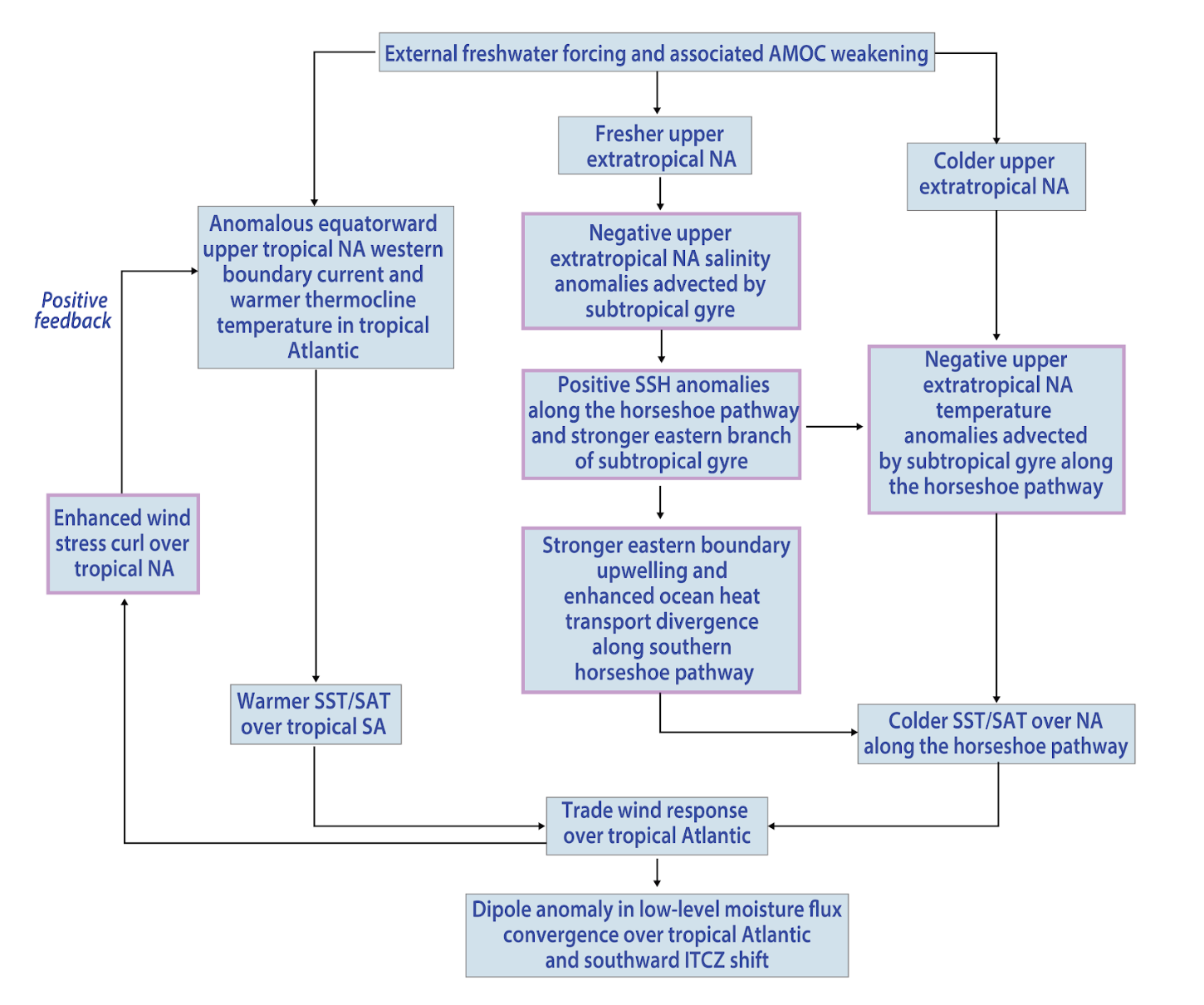
Schematic of the Atlantic extratropical-tropical teleconnection during boreal summer in response to external freshwater forcing.
The strength of this teleconnection is likely underestimated in climate models, partially due to mean-state biases in the North Atlantic Current pathway and associated underestimation of the AMOC-related surface heat flux released over the extratropical North Atlantic. It may also be partially related to mean state biases in the pathway/strength of the northeastern branch of the North Atlantic subtropical gyre and the eastern boundary upwelling/thermocline structure over the tropical eastern South Atlantic. Addressing these biases in future climate models will likely be crucial for accurately representing the Atlantic extratropical-tropical teleconnection and its associated tropical atmospheric responses, including the ITCZ shift.
Joshi, R., and R. Zhang, 2025: On the Atlantic extratropical-tropical teleconnection in response to external freshwater forcing. npj Clim. Atmos. Sci., 8, 371, https://doi.org/10.1038/s41612-025-01253-z.
Topics
- Air-Sea
- AMOC
- Atlantic Ocean