
How interfering waves drive the MJO
The Madden-Julian Oscillation (MJO) is the primary driver of weather variability on multi-week timescales. Characterized by a massive "see-saw" of tropical thunderstorms and clear skies, it moves eastward from the Indian Ocean across the Pacific roughly every 40 to 60 days. For decades, scientists have tracked the MJO using indices that essentially treat it as a single wave. However, this singular approach often struggles to explain why some MJO events stall over the Maritime Continent while others exhibit widely varying propagation speeds.
A recent study published by Marsico et al. (2026) offers a new explanation: the MJO is not a single entity, but a superposition of multiple distinct "modes" that interfere with one another. Using a data-driven model, researchers isolated two primary atmospheric modes: a "fast" mode with a 45-day period and a newly identified "slow" mode with a 70-day period.
The study demonstrates that the MJO’s evolution is often driven by how these two modes interfere. The most predictable MJO events occur through a process of constructive interference. These events often begin with the two modes out of phase over the Indian Ocean, but as they evolve and move into phase, they align. This alignment allows the MJO to maintain its strength even as the individual modes begin to decay.
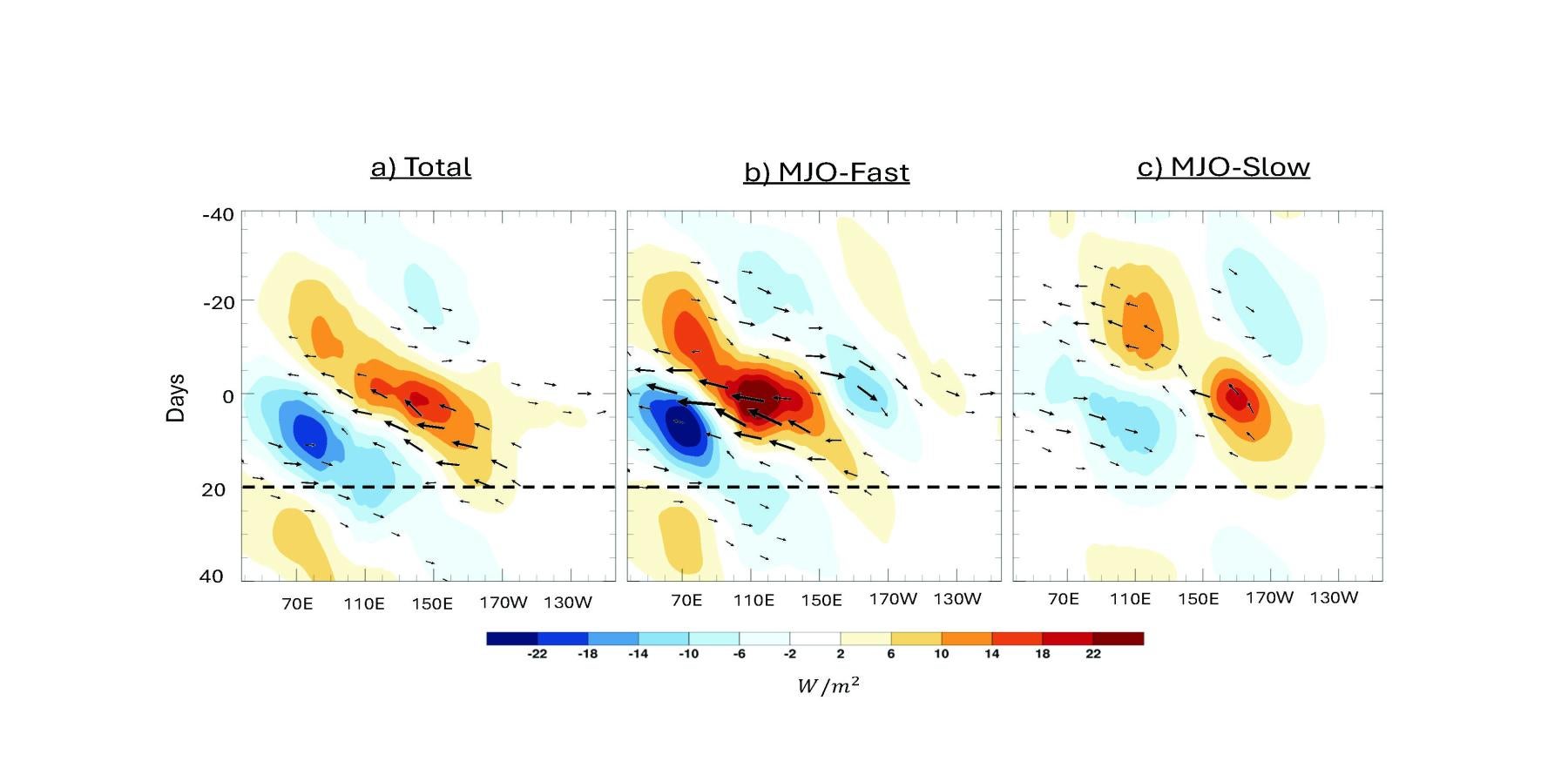
Analysis of the most predictable MJO events reveals they are driven by the interference of two distinct modes. At early lead times (day 0), the "MJO-fast" and "MJO-slow" modes are out of phase. As they propagate eastward, they align constructively (the dashed line at day 20), causing the MJO signal to maintain its strength even as the individual modes decay.
This discovery has significant implications for weather forecasting. By identifying these modal interferences at the start of a forecast, researchers can pinpoint "forecasts of opportunity." In the operational model of the European Center for Medium Range Weather Forecasting, these specific cases showed a remarkable boost in predictability, extending the reliable forecast range by approximately one full week compared to typical conditions. By resolving the distinct physical modes that comprise the MJO, this research provides a clearer lens for understanding the tropical disturbances that modulate weather worldwide.
Marsico, D. H., J. R. Albers, M. Newman, M. Gehne, J. Dias, G. N. Kiladis, E. LaJoie, and Y. Wang, 2026: Modal interference drives Madden-Julian Oscillation evolution and predictability. Geophys. Res. Lett., 53, e2025GL118062, https://doi.org/10.1029/2025GL118062.
Topics
- Air-Sea
- Indian Ocean
- Modeling
- Pacific Ocean
- Weather