
What explains the interannual variability of O2 content and distribution in the tropical Pacific?
Marine ecosystems and fisheries in the tropical Pacific exhibit substantial year-to-year variability associated with El Niño Southern Oscillation (ENSO). While much of this ecosystem variability has been attributed to ENSO-driven changes in temperature and primary productivity due to changes in nutrient supply, little is known about the role and variability of other key ecosystems drivers such as dissolved oxygen (O2), a critical component of metabolic activity for predators and lucrative fisheries such as tuna. In this region, models have suffered from large biases in representing the distribution of O2, while basin scale O2 observations have long been severely under-sampled.
To address these gaps, Eddebbar et al. (2026) employed high-resolution (~0.1º) and low-resolution (~1º) global model simulations of ocean circulation and biogeochemistry along with a machine learning-based estimate of O2 derived from BGC Argo floats. Both observations-based and modeling products reveal that El Niño and La Niña events significantly modulate the O2 content and distribution in the tropical Pacific. During El Niño, the eastern tropical Pacific experiences an excess of O2, while the western Pacific exhibits less O2, and vice versa during La Niña events. The ENSO-driven O2 variability in the eastern tropical Pacific is particularly of interest due to the presence of oxygen minimum zones in this region where O2 variability is found to be governed by opposing physical and biological drivers. During El Niño, reduced upwelling of low-O2 waters and weaker O2 consumption at depth prevail over the reduction in O2 ventilation by weaker turbulent mixing and suppressed lateral supply by the Equatorial Undercurrent. During La Niña, O2 ventilation by turbulent mixing and lateral advection is intensified, but enhanced upwelling of low-O2 nutrient rich waters along with intensified consumption of O2 at depth due to an increase in surface productivity overcompensate for the ventilation changes, leading to a net reduction of O2 in the eastern tropical Pacific. Thus while ENSO has a leading order effect on O2 ventilation in the eastern tropical Pacific, changes in upwelling and biological activity play a more dominant role in setting the O2 content and distribution in this region.
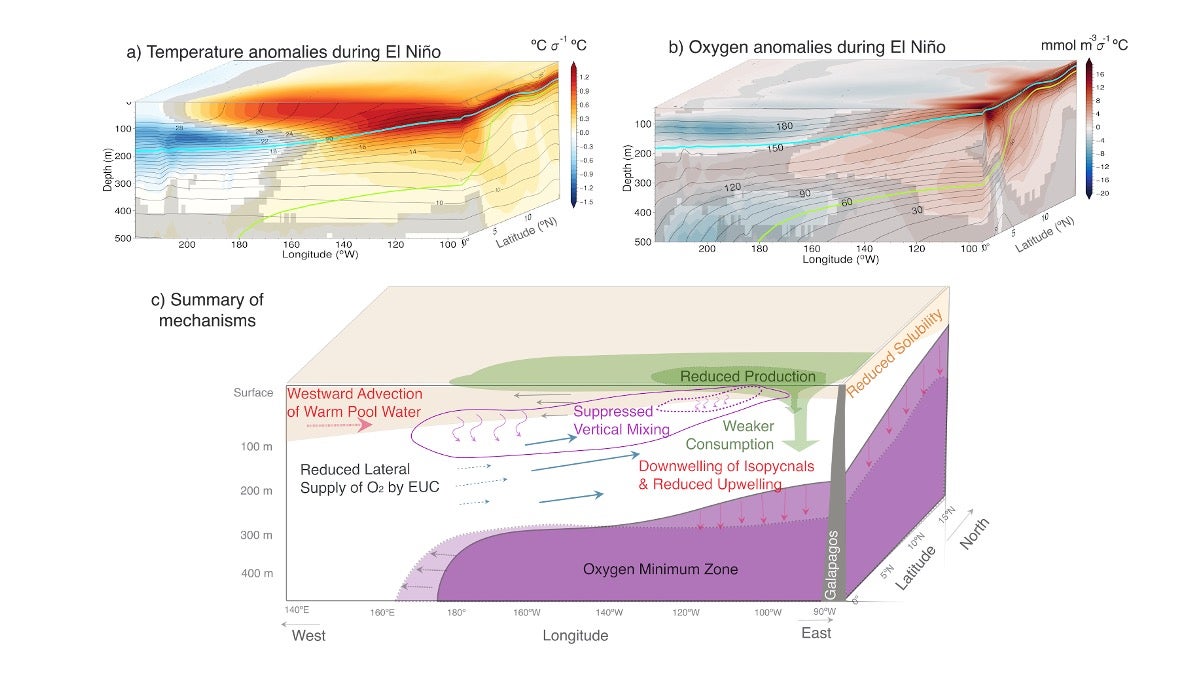
ENSO imprints on temperature and oxygen shown as regression of Nino 3.4 index on (a) temperature anomalies, and (b) oxygen anomalies in a high resolution simulation of CESM. Panel (c) shows a summary of main mechanisms driving the O2 response to El Niño events.
Future changes in the tropical Pacific O2 are thus likely to be driven not only by the large-scale reduction on O2 ventilation from higher latitudes due to ocean warming, but may also be highly sensitive to local changes in equatorial Pacific circulation and productivity associated with coupled ocean-atmosphere interactions.
Eddebbar, Y. A., E. L. Hoffman, J. D. Sharp, D. B. Whitt, A. C. Subramanian, and S. Stevenson, 2026: ENSO-driven variability of oxygen content and distribution in the Tropical Pacific. J. Climate, 39, 1333-1353, https://doi.org/10.1175/JCLI-D-25-0476.1.
Topics
- Air-Sea
- Ecosystem Impacts
- ENSO
- Modeling
- Pacific Ocean