
Small-scale seafloor roughness has outsized effects on seamount-driven ocean mixing
The deep ocean is filled with tens of thousands of seamounts—underwater mountains that stir and mix the abyss as currents flow past them. This stirring plays a crucial role in the global ocean energy budget and makes seamounts key hotspots for energy dissipation. By setting where and how vigorously deep waters mix, this process helps regulate the ocean's overturning circulation. But because seamounts are hard to represent in numerical models (for example, they are too small for global climate models to include in detail), their role is usually estimated using simplified, smooth shapes that ignore the geometric complexity of their smaller scales (i.e. roughness).
Chor et al. (2026) use state-of-the-art turbulence-resolving large-eddy simulations to ask: how much does the small-scale roughness of real seamounts actually matter? They simulate flow past realistic seamounts at a range of smoothing levels, and then sweep across the rotation and stratification regimes that seamounts experience globally.
The results reveal that resolving small-scale roughness increases the rate at which currents lose energy by up to a factor of ten, and increases turbulent mixing by a factor of three. This effect is neatly organized by the Slope Burger number (which is a measure of how dynamically steep the seamount is), and it is most pronounced where stratification is weak relative to rotation—exactly the regime that dominates the Southern Ocean, where the swift Antarctic Circumpolar Current makes seamount-driven dissipation especially energetic.
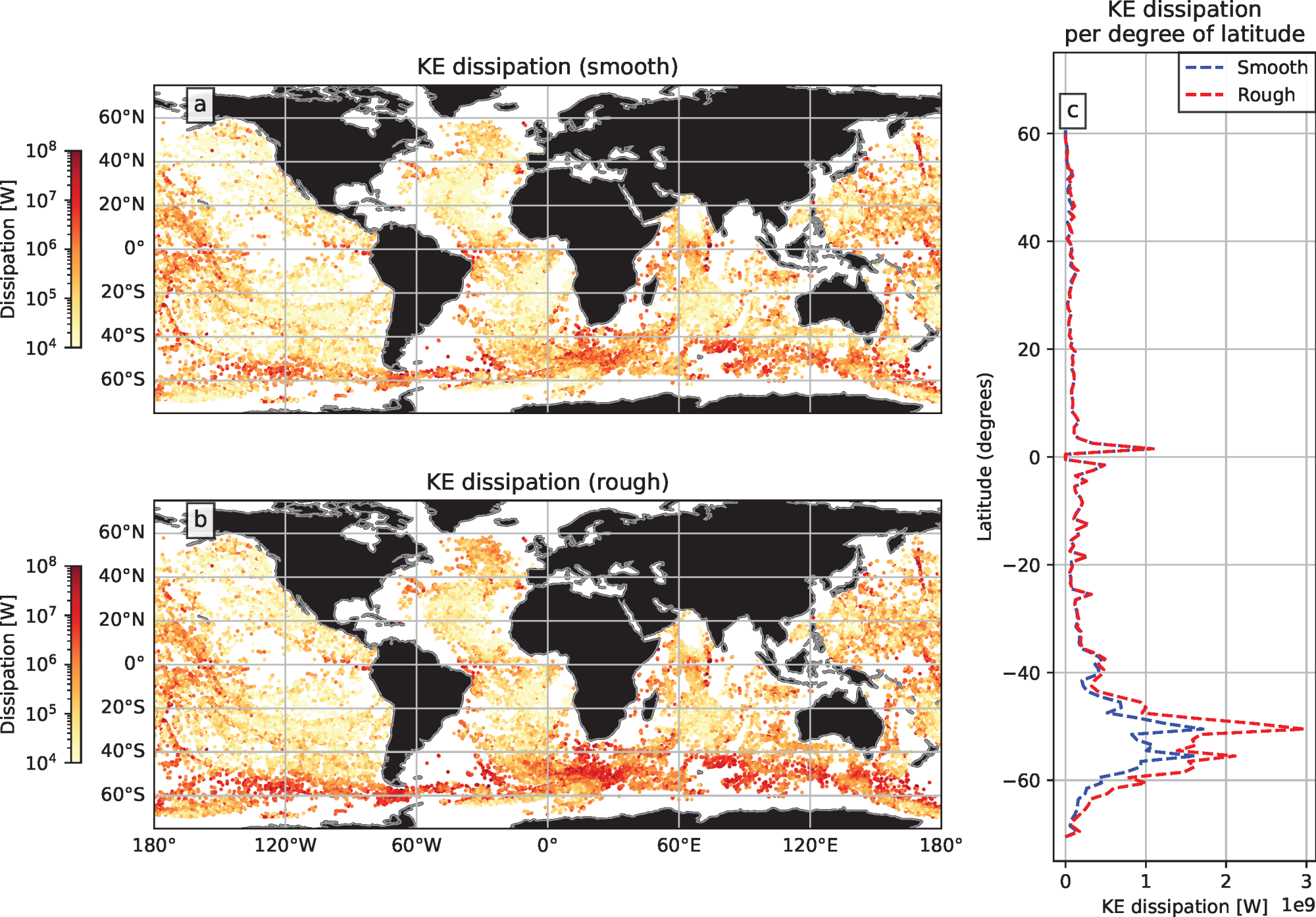
Combining scaling laws with a global seamount census, the authors estimate that roughly 30% of the kinetic energy dissipated by seamounts worldwide — and 40% in the Southern Ocean alone—is attributable to bathymetric details too fine to be resolved in current ocean models. Capturing these effects directly would require horizontal grid spacings of order 100 m, well beyond the reach of foreseeable global simulations. The results point to a clear opportunity: parameterizations that account for unresolved seafloor roughness, analogous to existing wave-drag schemes, could meaningfully improve how climate models represent deep-ocean mixing.
Chor, T., J. Wenegrat, and G.L. Wagner, 2026: Turbulent mixing and dissipation around rough seamounts. Geophysical Research Letters, 53, e2025GL121312. https://doi.org/10.1029/2025GL121312
Topics
- AMOC
- Modeling
- Southern Ocean