
Beyond wind-driven mixing: New insights into vertical exchange at a coastal front
Coastal oceans are among the most productive and socioeconomically important regions in the ocean, yet these ecosystems face mounting threats. The northern Gulf of Mexico is a striking example: Nutrient-rich freshwater discharged by the Mississippi-Atchafalaya River system fuels high biological productivity. The freshwater input also stratifies the water column, acting as a barrier that prevents surface and bottom waters from mixing. Each summer, oxygen in the isolated bottom waters is consumed by biological activity faster than it can be replenished, giving rise to one of the world's largest seasonal hypoxic zones. This "dead zone" threatens the Gulf’s ecosystem with benthic communities and commercially vital shrimp populations among the most vulnerable. Consequently, understanding when the stratification barrier breaks is essential for predicting the future health of this and similar ecosystems.
Wind-driven turbulent mixing during storms is considered the primary mechanism capable of ventilating these bottom waters. Körner et al. (2026), now identify symmetric instability (SI) as an additional, more energy-efficient pathway. SI is characterized by overturning motions aligned along density surfaces. SI drives vertical exchange in two ways: (1) through the direct advection by the overturning cells themselves, and (2) through turbulent mixing generated in the shear zones between cells. Because SI operates at small spatial scales and evolves rapidly, it has been difficult to observe directly, and much of what is known about it comes from numerical simulations.
Körner et al. (2026) present an unprecedented observational picture of SI at a freshwater front on the Louisiana shelf. Their high-resolution, two-ship surveys reveal overturning cells spanning the full water column, producing alternating intrusions of warm, oxygen-rich and cool, oxygen-poor water. Remarkably, these cells persisted for nearly two days after the instability triggering winds had died down. During this wind-quiet period, advective fluxes of heat and oxygen exceeded turbulent fluxes by roughly an order of magnitude and were large enough to potentially prevent hypoxic conditions locally.
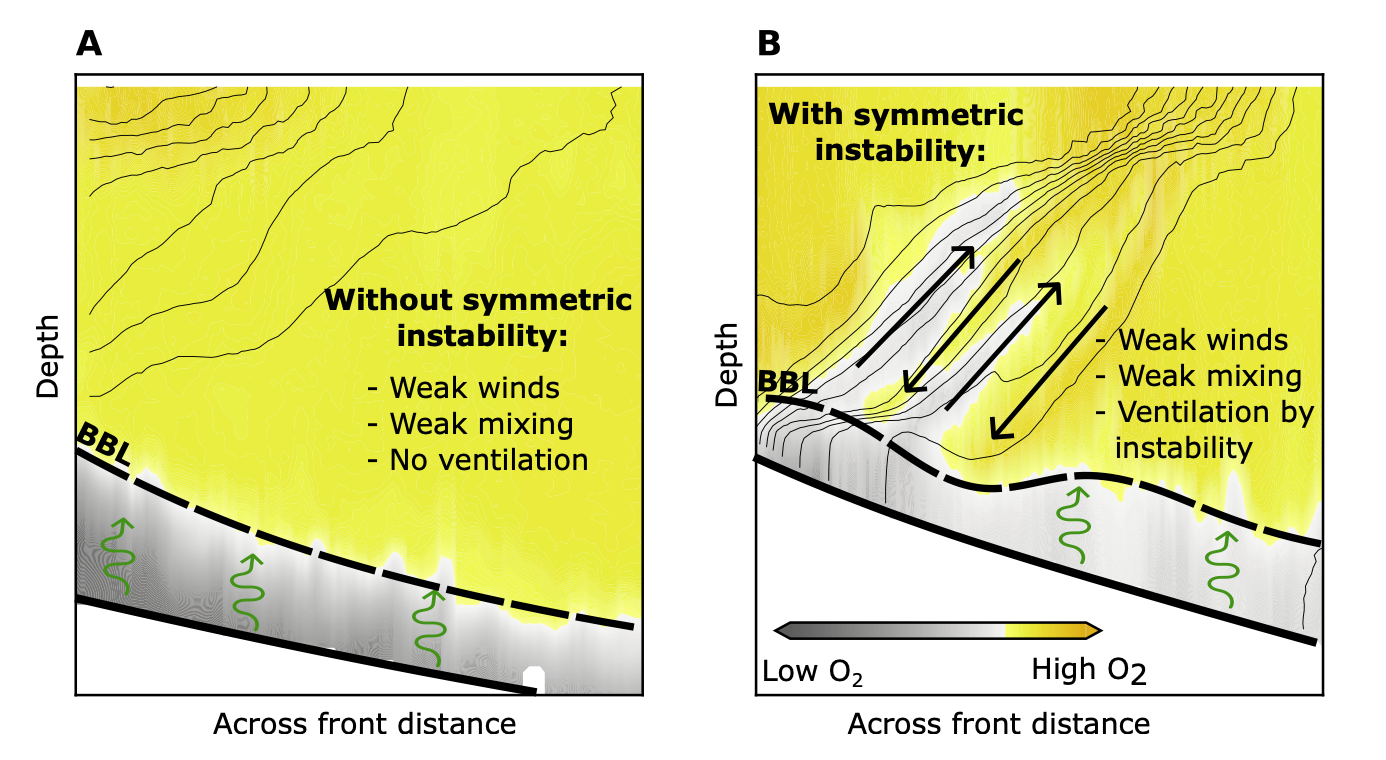
Schematic sections illustrating the role of symmetric instability (SI) in driving vertical oxygen flux. Panels show two cross-frontal oxygen sections: (A) before the instability event (22 June 2021), under weak wind conditions, and (B) shortly after wind forcing ceased (3 July 2021), during which SI, triggered by a preceding wind event, continues to persist. The dashed black line marks the extent of the bottom boundary layer (BBL), and thin black lines indicate isopycnals. Green curly arrows indicate turbulent mixing, whereas black straight arrows denote advection. In the absence of wind forcing and active mixing, vertical exchange is negligible in (A), resulting in poorly ventilated bottom waters. In contrast, (B) shows the enhanced ventilation of deeper waters during the instability event, driven by slantwise overturning cells.
This study sheds new light on SI as a driver of vertical exchange in stratified coastal waters. Given that similar conditions arise at other coastal boundaries as well, these findings may add an important piece to the puzzle of understanding vertical exchange between surface and bottom waters.
Körner, M., and Coauthors, 2026: Symmetric instability drives exchanges between surface and bottom waters in a coastal front. Sci. Adv., 12, eaeb9841(2026), https://www.science.org/doi/10.1126/sciadv.aeb9841.
Topics
- Air-Sea
- Ecosystem Impacts
- Ocean Heat