
Stratospheric ozone depletion causes Southern Ocean cooling
The Southern Ocean has exhibited a notable surface cooling trend since the satellite era, contrasting with the rapid global warming observed globally. Although several mechanisms have been proposed, including internal variability, atmospheric teleconnections, freshwater forcing, and changes in Southern Hemisphere westerly winds, the contribution of stratospheric ozone depletion remains uncertain. Li et al. (2026) quantified the transient influence of stratospheric ozone depletion on Southern Ocean sea surface temperature (SST) changes during 1982–2005 using coupled climate model simulations from CMIP5 and CMIP6 combined with observational datasets. By applying stratospheric ozone-only simulations, they isolated the SST response attributable to ozone depletion while excluding other external forcing factors.
The study demonstrated that stratospheric ozone depletion contributed significantly to Southern Ocean surface cooling by altering atmospheric circulation and ocean surface transport. Ozone depletion strengthened and shifted poleward Southern Hemisphere westerly winds, which enhanced northward Ekman transport and promoted cold-water advection, leading to SST cooling particularly south of 46°S. In addition, ozone-driven SST changes modified the meridional SST gradient, further amplifying Ekman-induced cold-water advection. The authors found that changes in wind stress accounted for the majority of the Ekman-driven cooling, while changes in the meridional SST gradient provided an additional contribution.
Furthermore, the study showed that sustained horizontal cold-water advection associated with enhanced Ekman transport was the dominant mechanism maintaining ozone-induced Southern Ocean cooling. Although surface heat flux adjustments and vertical advection partially offset this cooling, their effects were insufficient to overcome the influence of oceanic transport. Stratospheric ozone depletion also contributed to regional Antarctic sea-ice expansion, although other processes, including internal variability and freshwater forcing, were required to fully explain observed changes. Overall, Li et al. (2026) highlight the important role of stratospheric ozone depletion in recent Southern Ocean climate variability through its influence on atmospheric circulation and wind-driven ocean dynamics.
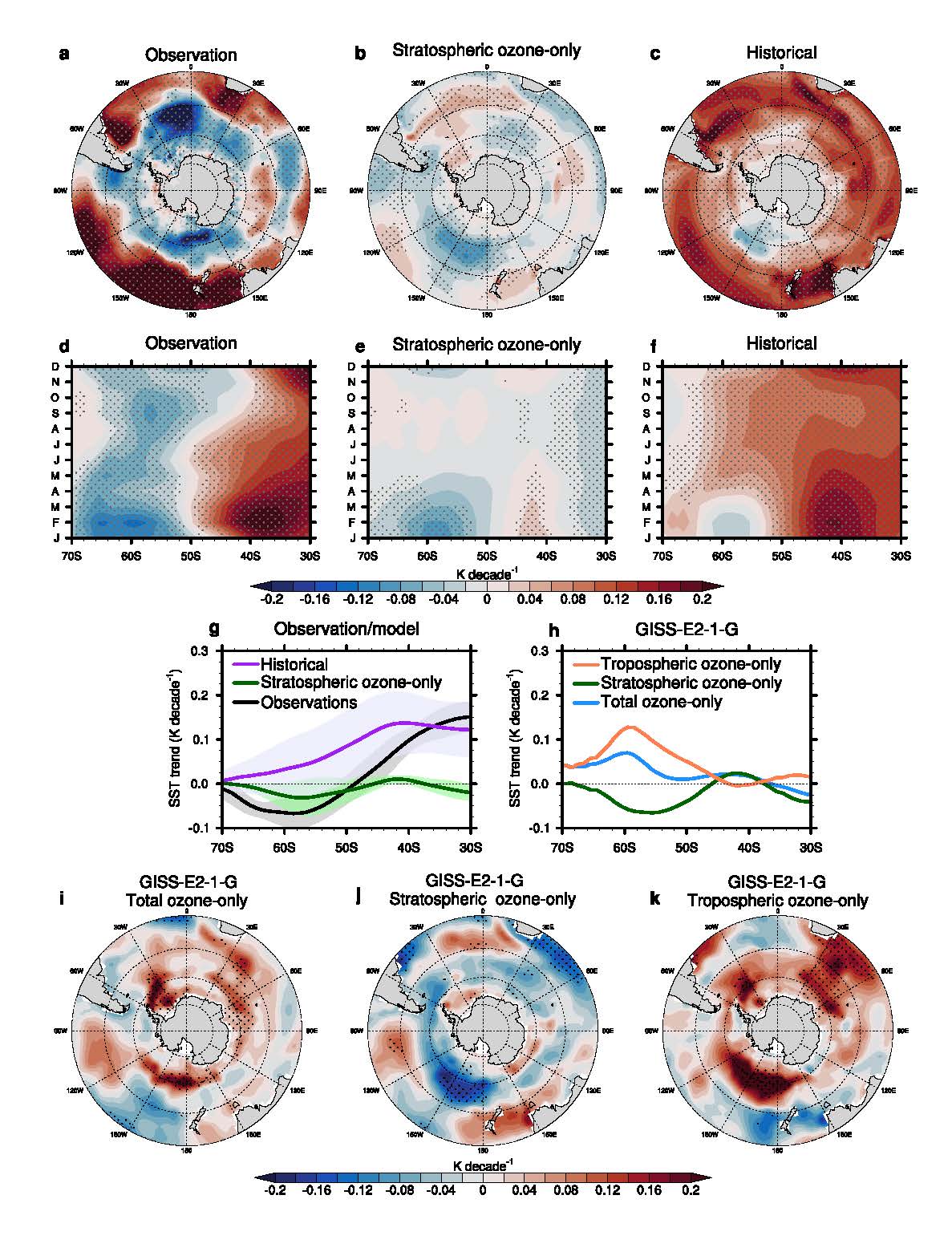
Li, S., Liu, W., Zhang, L., Seviour, W. J. M., & Schmidt, G. A. (2026). Stratospheric ozone depletion causes Southern Ocean surface cooling. Geophysical Research Letters, 53, e2025GL120200. https://doi.org/10.1029/2025GL120200
Topics
- Antarctica
- Ice Sheet
- Modeling
- Ocean Heat
- Southern Ocean