
Changes in eddy kinetic energy from 1950 to 2050 in the EERIE ensemble of eddy-rich climate models
Anne Marie
Treguier
LOPS (CNRS-UBO-Ifremer-IRD), Brest
Poster
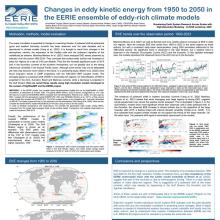
EERIE (European Eddy Rich Earth System Models, https://eerie-project.eu) is a European project aimed at developing a new generation of Earth System Models (ESMs) that are capable of explicitly representing ocean mesoscale eddies. We diagnose the geostrophic eddy kinetic energy from daily sea surface height in five models (EERIE and HighResMIP, with a grid scale of 10 km or finer). The multi-model mean reproduces the energy increase observed from 1993 to 2023 by satellite altimetry in the Antarctic Circumpolar Current, and also some dipolar patterns in the Kuroshio extension, suggesting that these changes could be a forced response rather than internal variability. Over a century, from 1950 to 2050, the EERIE multimodel ensemble confirms most of the evolutions diagnosed in an earlier version of the AWI model (Beech et al, 2022). In the models, changes in mean and eddy kinetic energy are related, as expected for eddy energy generated by instabilities of the mean flow.
Poster file
treguier-annemarie-highres.pdf
(1.49 MB)