
Exploring the Role of Southern Hemisphere Ozone Depletion in Southern Ocean and Tropical Cooling Trends in High-Resolution CESM Historical Simulations
Xue
Liu
Texas A&M University
Poster
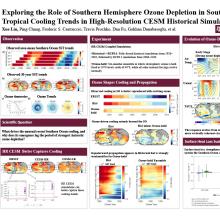
Using a high-resolution CESM historical ensemble simulation, we examine how Antarctic stratospheric ozone depletion influences the climate trends in the Southern Ocean (SO) and the tropics. The historical simulation capture cooling in both regions, while an ozone withholding ensemble simulation, in which Antarctic stratospheric ozone is fixed at its 1970 level, shows a weaker SO cooling and no tropical cooling. These results indicate that ozone depletion plays a crucial role in initiating both local SO response and the remote tropical response. Further analyses reveal a two-stage evolution. During the initial stage from 1970-2000 when ozone depletion is strongest, pronounced stratospheric cooling is accompanied by an intensification of the upper-level winds over SO. A stationary Rossby wave pattern emerges over the Pacific sector, providing a dynamical linkage between the SO and tropics. Despite these atmospheric changes, SST and surface winds remain largely unchanged. In the later stage from 1980 to 2010, a pronounced SO surface cooling develops, together with a strengthening of the westerlies that extends into the upper atmosphere. A tropical cooling trend also emerges during this period, pointing to the role of ocean–atmosphere coupling in amplifying and sustaining the response.
Overall, these results suggest that ozone forcing initiates the cooling, while coupled atmosphere-ocean feedbacks and SO-tropics interactions amplify and maintain the response. Ongoing analyses aim to quantify the relative contributions of these processes.
Overall, these results suggest that ozone forcing initiates the cooling, while coupled atmosphere-ocean feedbacks and SO-tropics interactions amplify and maintain the response. Ongoing analyses aim to quantify the relative contributions of these processes.
Poster file
Liu-Xue-HighRes.pdf
(2.03 MB)