
Mechanism of oxygen changes in the northwest Atlantic Shelf from MOM6-NWA12 coupled with COBALT
Hung
Nguyen
University of Connecticut
Poster
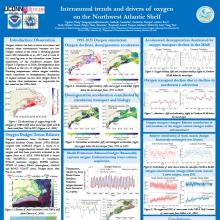
The northwest Atlantic (NWA) Shelf has experienced major biogeochemical shifts. The region is becoming less oxygenated, which has consequences for the region’s ecosystem. However, it is unclear whether this trend is locally produced or transported, thus posing a challenge for forecasting oxygen. In this study, we used a 1/12° regional model (MOM6-NWA12), downscaled from a 1° global forecast model and coupled with a biogeochemical model (COBALT), to simulate historical oxygen trends in the region. To evaluate the regional model, we compare its oxygen output and coastal processes with observations from various archives. To identify the mechanism underlying these changes, we estimated the budget terms associated with oxygen trends. Model evaluation indicates that the simulated oxygen trends are consistent with observations in the region. The budget analysis indicates that long-term oxygen is driven by both circulation shifts and local biological changes. The reduction in the oxygen end-member of the Gulf Stream, rather than its presence, determines the circulation effect.
Poster file
Hung Nguyen Poster.pdf
(2.92 MB)