
Higher model resolution alters the winter precipitation response to past and future warming in the western United States
Sophia
Macarewich
NSF NCAR
Poster
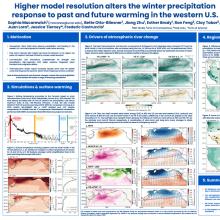
Atmospheric rivers (ARs) cause extreme precipitation and floods and are expected to intensify in the future. Past climate states with elevated atmospheric CO2 provide insight for future AR activity, yet our understanding of paleo-ARs has been partially limited by coarse (>1°) Earth system simulations. Previous work has demonstrated that coarse simulations severely underestimate AR strength and precipitation compared to observations, while using higher grid resolution improves the representation of AR intensity and orography in landfalling regions. To better understand ARs under different warming transitions, we present new simulations of the Last Glacial Maximum (~21 ka; 190 ppm), mid-Pliocene (~3 Ma; 400 ppm), and preindustrial control using the Community Earth System Model version 1.3 (CESM1.3), and compare them with a future high-emission RCP8.5 scenario. The key advancement here is the use of a high (HR) and low-resolution (LR) CESM1.3 simulations (~0.25° and ~1° for the atmosphere and land models; ~0.1° and ~1° for the ocean and sea-ice models, respectively) to quantify the impact of grid resolution. In the coastal western U.S. which is heavily influenced by ARs, the frequency and intensity of ARs increase with warming across all transitions, leading to overall higher cool-season precipitation in the region. Notably, HR precipitation compares better with proxy records than the LR simulations. While the increase in AR activity is primarily due to the increase of atmospheric water vapor with warming, the role of wind-driven changes varies based on the climate state. With increased grid resolution, mid-latitude atmospheric circulation can shift such that relatively weakened winds counterbalance or amplify the influence of higher specific humidity and alter patterns of global AR activity. These simulations are an important step toward improving our understanding of precipitation change with warming by providing improved estimates of AR activity in the past.
Poster file
macarewich-sophia-highres.pdf
(6.95 MB)