
Emergent Predictability of Western U.S. Precipitation due to Anthropogenic Emissions in a High-Resolution Climate Model
Jeremy
Klavans
University of Miami
Poster
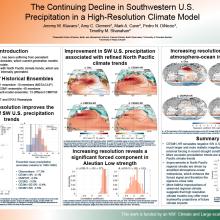
The southwestern United States has been besieged by decades of drought. In each of these decades, climate models have projected relieving rains that have failed to arrive. We could view these busted projections as bad luck, were it not for the global, systematic pattern of state-of-the-art climate models failing to anticipate observed trends. We believe this shortcoming is due to the signal-to-noise error, a bias wherein models underestimate externally forced regional trends relative to internally generated noise. Here we show that increasing model resolution enhances atmosphere-ocean interactions, yielding dramatic improvements in the signal-to-noise ratio and therefore the simulation of North American hydroclimate. The simulated improvements in the signal-to-noise ratio builds confidence that new, high resolution climate models can provide actionable projections of regional climate change.
Poster file
klavans-jeremy-highres.pdf
(720.06 KB)