
Multidecadal convective variability of the Southern Ocean helps explain observed Antarctic sea ice expansion
Robert
Ford
University at Albany, SUNY
Poster
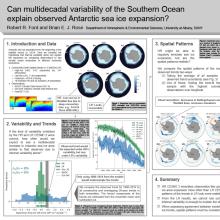
Satellite observations show that Antarctic sea ice expanded from the beginning of the record in the 1970s to about 2015, despite most climate models under historical forcing projecting sea ice loss over this period. A few explanations have been proposed, including circulation changes associated with ozone depletion, increased stratification associated with Antarctic meltwater, and internal variability, the last of which we consider here. We show that the high-resolution (HR) version of the CESM1.3 used for the MESACLIP project exhibits multidecadal variability in Weddell Sea deep convection, allowing for multidecadal periods of Antarctic sea ice expansion of the same magnitude as the trend in observations. The low-resolution version of the CESM1.3 does not have this type of variability, and as a result, it shows the usual disagreements in Antarctic sea ice trends between models and observations. While the mechanisms responsible for the convective variability in HR CESM1.3 are still under debate (e.g., Ford and Rose, 2026, GRL), the significant difference in variability between the two model resolutions points to the importance of simulating oceanic mesoscale eddies. We then examine the spatial patterns of the periods of sea ice expansion and find that there is some agreement between the HR model and observations. Trends in the regions where the open-ocean polynyas occur may be overemphasized, but the limited observational record makes this assessment difficult.
Poster file
ford-robert-highres.pdf
(1.79 MB)