
High-resolution simulations reconcile observed Pacific climate trends with anthropogenic forcing
Sieu-Cuong
San
University of Colorado Boulder
Poster
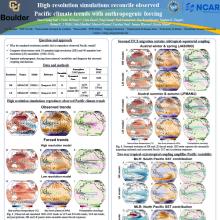
Ongoing multidecadal trends in the Pacific ocean–atmosphere system are not replicated by standard-resolution climate models, leaving open whether they represent an outlying realization of internal variability, a forced response that models fail to simulate or a combination thereof. Resolving this discrepancy is critical for projecting impacts such as megadrought risk, regional sea-level rise, and tropical cyclone activity. Using a large ensemble of high-resolution coupled simulations, we identify an anthropogenically forced response that accounts for much of the observed Pacific trend pattern and suggests comparable contributions from forced and internal variability rather than an extreme realization of the latter. The forced signal emerges through amplification of tropical–extratropical ocean-atmosphere interactions, enabled by realistic simulation of seasonally migrating rainbands and ocean mesoscale dynamics, producing a Pacific-wide pattern resembling internally generated variability but driven by anthropogenic forcing. Our results suggest that the apparent model–observation discrepancy in Pacific climate trends arises from unresolved multiscale processes rather than fundamental deficiencies in climate model dynamics.
Poster file
san-cuong-highres.pdf
(5.53 MB)