
Atmospheric Response to North Atlantic Mesoscale Eddies and Fronts
Robert
Sasse
CNRS, Physical and Spatial Oceanography Laboratory
Poster
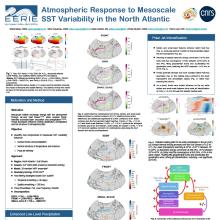
We investigate the atmospheric response to distinct mesoscale SST features using a 30-member Weather Research and Forecasting (WRF) ensemble with three SST configurations designed to isolate the impacts of transient eddies, stationary fronts, and small-scale SST variability. Simulations were performed on a 30-km resolution domain from September 2005 to September 2006, a period with a neutral wintertime North Atlantic Oscillation (NAO) index.
Distinct atmospheric responses emerge for each SST structure. Quasi-stationary SST fronts primarily influenced the lower troposphere, where enhanced surface fluxes increased moisture availability and strengthened precipitation over the Gulf Stream. Conversely, transient mesoscale eddies modified the upper tropospheric circulation by increasing diabatic heating and contributing to subtropical jet intensification. These results highlight that SST signatures of quasi-staionary permanent front and of transient mesoscale eddies influence the atmosphere through distinct vertical pathways.
Distinct atmospheric responses emerge for each SST structure. Quasi-stationary SST fronts primarily influenced the lower troposphere, where enhanced surface fluxes increased moisture availability and strengthened precipitation over the Gulf Stream. Conversely, transient mesoscale eddies modified the upper tropospheric circulation by increasing diabatic heating and contributing to subtropical jet intensification. These results highlight that SST signatures of quasi-staionary permanent front and of transient mesoscale eddies influence the atmosphere through distinct vertical pathways.
Poster file
Sasse_Robert_highres2.pdf
(2.34 MB)