
The Influence of Model Resolution on Future Moist-Heat Projections
Wyatt
Petryshen
Yale University
Poster
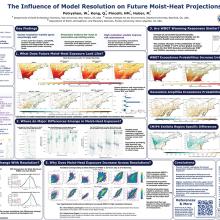
Extreme moist heat poses significant risks to human health, agriculture, and infrastructure. These events are expected to increase in both intensity and frequency under anthropogenic warming. Moist heat is influenced by large-scale atmospheric circulations and thermodynamics, as well as smaller-scale processes, including mesoscale dynamics and land–atmosphere interactions that modulate local extremes. Many climate-impact assessments rely on coarse-resolution global climate models or statistically downscaled products to evaluate future risks. However, these approaches do not explicitly resolve many of the mesoscale processes that influence local heat and moisture extremes. It remains unclear how projections of moist-heat extremes vary when these smaller-scale processes are explicitly represented.
Here, we evaluate how projections of wet-bulb globe temperature (WBGT) change with increasing model resolution using dynamically downscaled CESM-MOAR (RCP8.5) simulations produced with the Weather Research and Forecasting (WRF) model over New England. The WRF simulations include three nested domains, ranging from 27-km regional climate simulations to 3-km convection-permitting simulations, providing a framework for examining how WBGT distributions and extremes evolve as key physical processes become increasingly resolved. To place these results in the context of existing climate-impact assessments, we compare WRF-derived WBGT distributions with an existing set of statistically downscaled and bias-corrected WBGT projections.
Our comparison focuses on the shape of WBGT distributions, particularly the upper tail associated with the most extreme values, across the resolution hierarchy and between statistical and dynamical downscaling at equivalent global warming levels. Systematic differences in the upper tail may indicate sensitivity to processes that are better represented at convection-permitting resolution. This framework provides a direct assessment of the extent to which increasing model resolution alters projections of future moist-heat hazards.
Here, we evaluate how projections of wet-bulb globe temperature (WBGT) change with increasing model resolution using dynamically downscaled CESM-MOAR (RCP8.5) simulations produced with the Weather Research and Forecasting (WRF) model over New England. The WRF simulations include three nested domains, ranging from 27-km regional climate simulations to 3-km convection-permitting simulations, providing a framework for examining how WBGT distributions and extremes evolve as key physical processes become increasingly resolved. To place these results in the context of existing climate-impact assessments, we compare WRF-derived WBGT distributions with an existing set of statistically downscaled and bias-corrected WBGT projections.
Our comparison focuses on the shape of WBGT distributions, particularly the upper tail associated with the most extreme values, across the resolution hierarchy and between statistical and dynamical downscaling at equivalent global warming levels. Systematic differences in the upper tail may indicate sensitivity to processes that are better represented at convection-permitting resolution. This framework provides a direct assessment of the extent to which increasing model resolution alters projections of future moist-heat hazards.
Poster file
Petryshen-Wyatt-highres.pdf
(8.13 MB)