
Beyond local wind: How remote forces shape Pacific equatorial upwelling
Equatorial Pacific upwelling shapes Earth’s climate by regulating sea-surface temperatures, tropical precipitation, and the strength of the Walker circulation. Yet how this upwelling will respond to global warming remains uncertain. Traditional theory emphasizes a “pull from above,” in which easterly trade winds drive Ekman divergence and draw cold water upward. In contrast, studies of decadal variability highlight a “push from below,” where geostrophic lateral convergence in the equatorial thermocline shapes vertical transport. Understanding how these pathways share responsibility is essential for assessing the likely future patterns of climate change.
This study uses a local energetics framework to quantify the energy required to lift dense subsurface waters in the equatorial Pacific and to identify where that energy originates. Analyses of a coupled climate model reveal that 20–50% of equatorial upwelling cannot be powered by local winds along the equator, as commonly understood. Instead, this fraction of vertical motion is powered by potential energy stored within the tropical thermocline. This energy is supplied remotely: warm, low-density waters transported downwards in off-equatorial regions create buoyant layers that later flow equatorward. As these thermocline waters move equatorward, they rise using their own buoyancy surplus, effectively “pushing” equatorial upwelling from below without additional energy inputs. The majority of this energy comes from warm overturning cells within 10° of the equator, but further contributions originate from downwelling in the subtropical gyres.
The strength of this upward push depends both on the equatorward transport within the thermocline and on the density contrast between those flows and the rest of tropical Pacific waters. Thus, the remote component of upwelling is shaped by both off-equatorial buoyancy and momentum forcing.
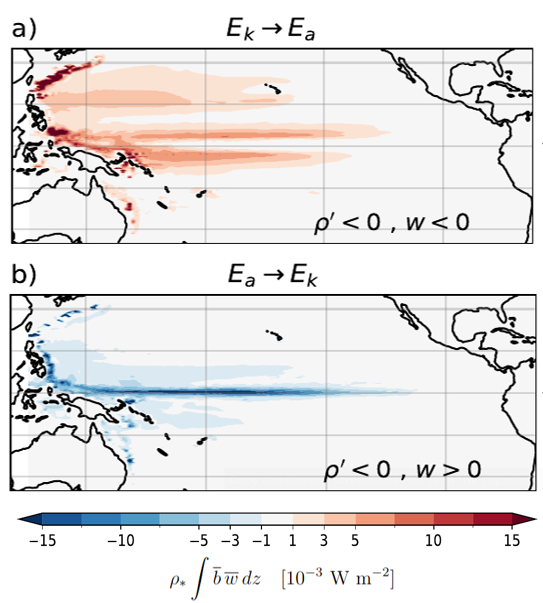
Conversions between kinetic (Ek) and available potential (Ea) energy for upward-buoyant (ρ'<0) water parcels in the upper Tropical Pacific. Conversions (a) Ek → Ea in downwelling (w<0) regions impart Ea to the thermocline, as low-density water parcels retain their buoyancy. Equatorward transport later ensures that energy is converted back to Ek, as patterns in (b) Ea → Ek show that upwelling (w>0) in the western equatorial Pacific is powered by the thermocline's own Ea.
Finally, the study presents evidence that variations in this remote energy pathway help sustain changes in upwelling during ENSO events. Anomalies in off-equatorial forcing, or internal ocean dynamics can therefore modify the thermocline tilt and influence the growth or decay of ENSO events. By tracing all energetic pathways rather than relying solely on a local momentum balance, this work provides a new diagnostic perspective for understanding changes in equatorial Pacific upwelling across seasonal, interannual, and decadal timescales.
Brizuela, N. G., C.-Y. Lee, A. H. Sobel, R. Seager, S. J. Camargo, and J.-Y. Zhuo, 2025: Tropical thermocline helps power Pacific equatorial upwelling. J. Phys. Oceanogr., 55, https://doi.org/10.1175/JPO-D-24-0178.1.
Topics
- Air-Sea
- ENSO
- Internal Variability
- Pacific Ocean