
The hidden feedbacks driving Antarctic ice shelf melt
Antarctic ice shelf melt accounts for little sea-level rise today, but is projected to be a leading contributor by 2100. However, considerable uncertainty surrounds this estimate because one of the key drivers of ice shelf melt, ocean circulation, is understudied.
Youngs et al (2026) examine how climate change and melt‑driven feedbacks each influence the continental‑shelf and ice-shelf response to future climate change, using a circumpolar Antarctic ocean–sea ice model that incorporates interactive ice shelves. Authors describe this process as ice shelf–melt feedback, in which changes in ice shelf melt alter ocean circulation, which in turn affects the amount of heat transported into individual ice shelf cavities, further influencing melt rates. Such feedback can only be represented in models that explicitly couple ice shelf melt and ocean circulation through interactive thermodynamics, whereby melt rates respond to the properties of the water within the ice shelf cavities, and meltwater input can, in turn, modify ocean circulation.
These simulations reveal that the ice shelf response (or melt feedback) is of comparable importance, and in some regions opposite in sign, to the role of climate change itself. In the coldest regions where dense water is formed, warming creates a positive feedback loop: ice shelf melt freshens and lightens the shelf waters, allowing warming water to flow beneath the ice shelves and further enhances melting. On the other hand, the westward transport of meltwater from these “dense-shelf'' regions freshens the continental shelf further downstream, inhibiting warm-water intrusion and establishing negative feedback.
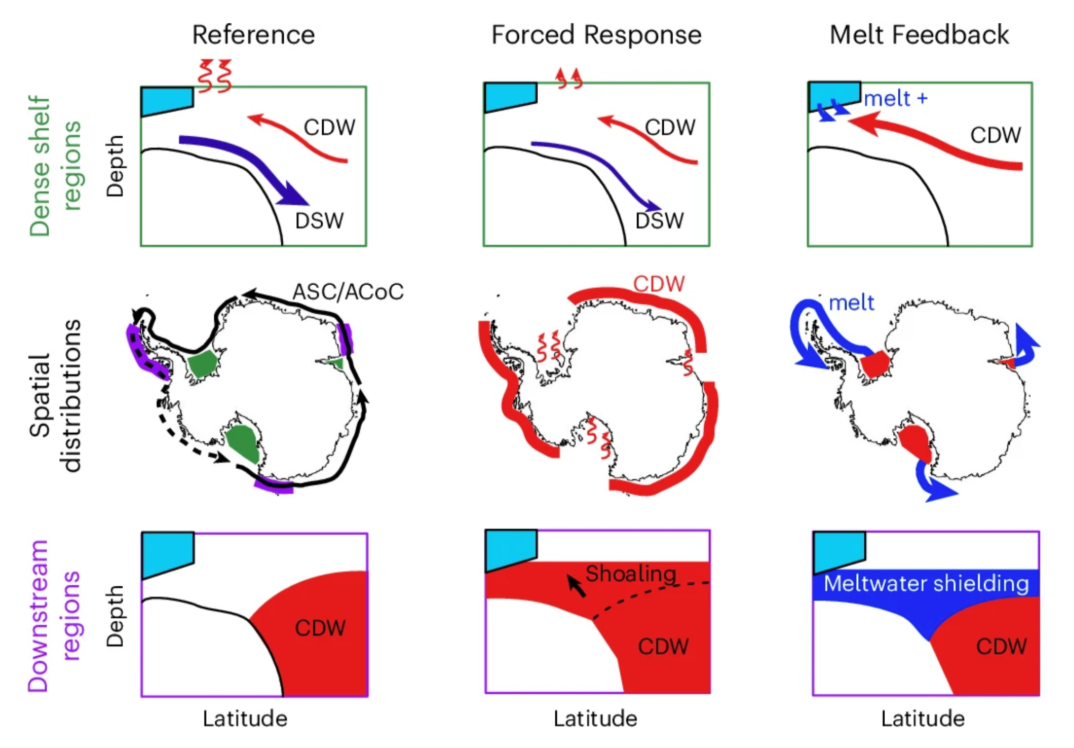
Climate change initially brings more warm water towards Antarctic ice shelves, increasing melting. However, the additional meltwater can circulate around Antarctica and act as a barrier that prevents warm water from reaching the ice shelves. This creates a feedback that can partially counteract the initial increase in melting.
Overall, these ocean–ice shelf interactions account for two-thirds of the increased melt rate over all ice shelves. However, this level of coupling is absent from most climate model projections. Consequently, the relative importance of ocean–ice shelf interactions and climate change to future Antarctic ice shelf melt remains poorly understood. This work highlights the importance of explicitly representing Antarctic ice shelf-melt interactions in climate models to improve projections of future climate change.
Youngs, M. K., A. L. Steward, Y. Si, A. F. Thompson, and M. P. Schodlok, 2026: Antarctic ice-shelf basal melt shaped by competing feedbacks. Nat. Geosci., 19, 675–682, https://doi-org.cuucar.idm.oclc.org/10.1038/s41561-026-01975-6.
Topics
- Antarctica
- Climate Change
- Ice Sheet
- Modeling
- Ocean Heat
- Sea Ice