
How are eddies energized in the California Current?
Mesoscale eddies, swirling currents roughly 100 km across, hold up to 80% of the time-dependent kinetic energy in the ocean. They are responsible for the distribution of heat, carbon, nutrients, and other tracers, shape marine ecosystems, and influence how the ocean exchanges heat with the atmosphere.
The upper ocean consists of a well-mixed surface layer called the "mixed layer" sitting above more stratified water. Upper-ocean stratification influences surface currents through multiple mechanisms, but the relative importance of these mechanisms has not been quantified. Stronger stratification can trap wind forcing in a shallow layer and accelerate surface currents, while weaker stratification leaves more energy stored in the upper ocean and promotes the release of this energy as submesoscale instabilities, which can ultimately energize larger flows.
Gazeley et al. (2026) examine both mechanisms in a high-resolution simulation of the California Current, run by the U.S. Naval Research Laboratory for March to October 2023. They use a filtering technique called coarse-graining, which quantifies the rate at which kinetic energy is exchanged between motions larger and smaller than a chosen length scale. Repeating this across a number of length scales shows whether eddies gain energy from smaller or larger motions. Energy transferred from large scales to small scales is called a forward cascade. Energy transferred from small scales to large scales is called an inverse cascade.
In winter and spring, mixed-layer instabilities energize mesoscale eddies through an inverse cascade. Storms deepen the mixed layer. When the winds relax, it restratifies and generates eddies and filaments only a few kilometers across. Over the following days these merge into larger eddies. A composite of more than 300 such events shows this sequence repeating through the season, and ceasing in summer.
In summer, shallow mixed layers favor accelerated surface currents and a forward cascade from larger scales. The same wind acts on a thinner layer of water with less inertia, so it accelerates that layer more efficiently and strengthens the large-scale California Current. Energy is then transferred downscale from currents larger than 100 km into the eddies, resulting in larger, smoother eddies than in winter and spring.
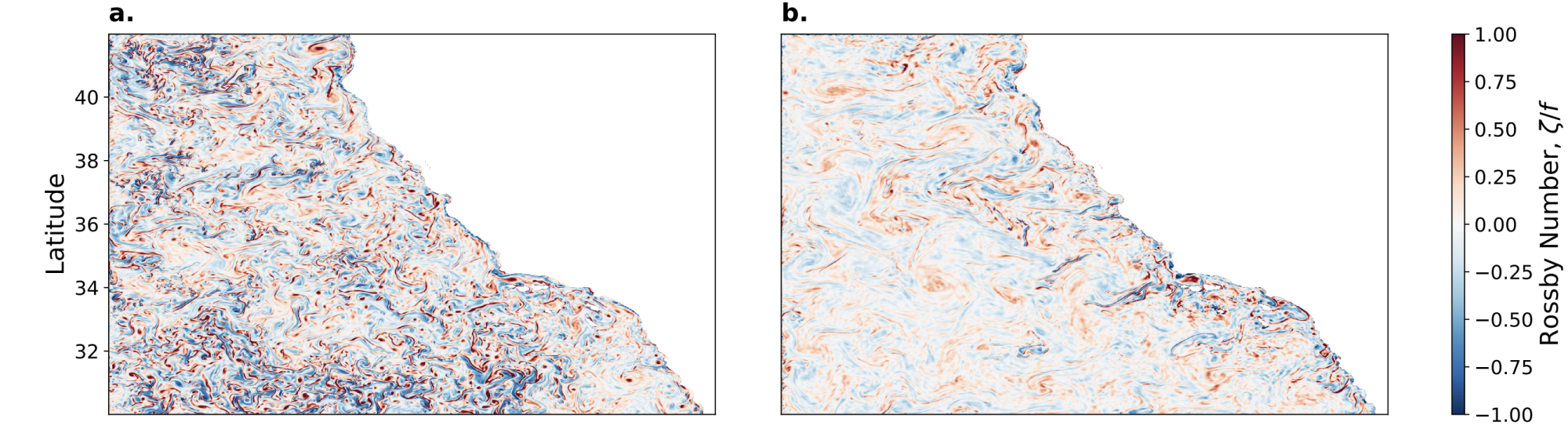
A snapshot of the vorticity normalized by the Coriolis parameter in the California Current on (a) 1st March 2023 and (b) 30 September 2023. Red indicates counterclockwise swirling while blue indicates clockwise. In March, small-scale, fast-rotating eddies dominate. Whereas in summer, smoother, larger, less intense eddies dominate. This is indicative of the eddies being generated and maintained by different mechanisms.
The importance of the inverse cascade implies that unresolved submesoscale motions can influence mesoscale variability and therefore have consequences for ocean predictability. Most climate and forecast models are too coarse to resolve these features.
Gazeley, J. F., S. T. Gille, L. Siegelman, A. C. Naveira Garabato, J. May, J. D’Addezio, and SP. Xie, 2026: Seasonal shift in the dominant pathway energizing mesoscale eddies in the California Current. J. Phys. Oceanogr., https://doi.org/10.1175/JPO-D-26-0092.1, in press.
Topics
- Internal Variability
- Modeling
- Ocean Heat