
Internal wave momentum transport may be necessary for accurate simulation of Equatorial Pacific SST
The Equatorial Pacific Cold Tongue, a region of cool sea surface temperatures (SSTs), influences global climate via its role in the Bjerknes feedback that drives the El Niño-Southern Oscillation (ENSO). However, state-of-the-art climate models struggle to accurately simulate this large-scale SST pattern, and the “Cold Tongue Bias” is a primary contributor to errors in ENSO predictions.
Dating back to the 1980s, observations of small-scale turbulence at 0°N, 140°W have been insufficient to account for the vertical momentum flux required to close the large-scale momentum budget, suggesting an incomplete understanding of the processes that move heat and momentum through the Cold Tongue region. Davenport et al. (2026) use a dynamically consistent, observation-constrained ocean model to investigate this deficit and argue that this long-standing puzzle may be related to SST biases.
The study uses the Tropical Pacific Ocean State Estimate (TPOSE) to diagnose momentum and temperature budgets at 0°N, 140°W during ENSO-neutral years. The authors compare the observation-constrained TPOSE viscosity against in situ turbulence measurements, Large Eddy Simulations (LES), and shipboard internal wave observations. The results show that the parameterization used to calculate vertical momentum flux in the model is consistent with the total momentum flux inferred from large-scale budget estimates. However, this parameterization assumes the flux is driven entirely by turbulent processes, and comparisons to independent observations and LES indicate that modeled turbulent viscosity is too strong (Figure). This supports the hypothesis that the zonal momentum budget cannot be closed by turbulence alone and that another physical mechanism supplies meaningful vertical momentum transport in the real ocean.
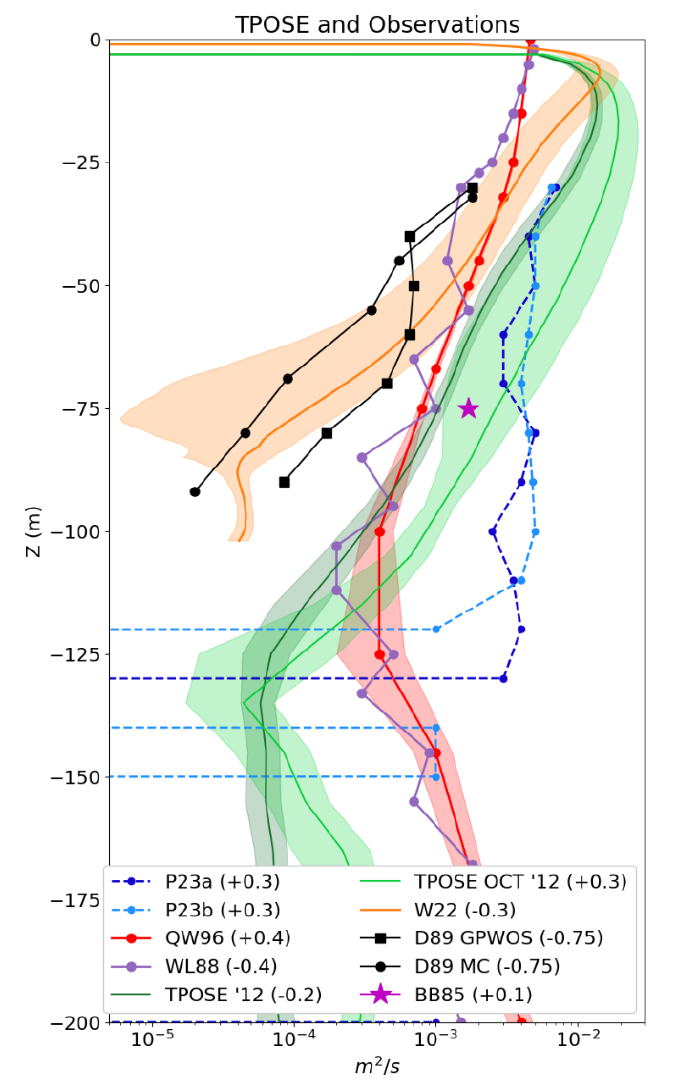
Figure. Comparison of effective viscosity profiles at 0°N, 140°W from multiple sources: the TPOSE ocean state estimate (green lines), large-scale budget residuals (magenta star, red and purple lines), direct microstructure turbulence measurements (black lines), Large Eddy Simulations (orange line), and internal wave observations (blue lines). TPOSE and budget residuals agree with one another but exceed microstructure and LES estimates by roughly an order of magnitude between 75 and 100 m depth (note the log-scale on the x-axis). Internal wave-based estimates are as large, if not larger, than budget residuals, suggesting that they could contribute meaningfully to vertical momentum transport.
Further analysis points to internal gravity waves, typically unrepresented in large-scale ocean models, as the most likely source of the necessary momentum flux that turbulence does not provide. Turbulence moves both heat and momentum vertically through the water column, while internal waves primarily transport momentum alone. The authors argue that the excess turbulence needed to close the zonal momentum budget in the model produces a vertical heat flux that is too strong, contributing to cold biases in simulated SST.
These findings suggest that accurately simulating Cold Tongue SST—and by extension ENSO— may require ocean models to separately represent turbulent and wave-driven momentum transport. Co-located microstructure and internal wave observations, paired with intermediate-scale models capable of resolving wave dynamics, will be essential to constrain these mechanisms and guide future parameterization development.
Davenport, E. H., A. Verdy, B. D. Cornuelle, M. R. Mazloff, R. Pinkel, A. F. Waterhouse, and D. B. Whitt, 2026: Vertical momentum flux at 0°N, 140°W: Unresolved internal waves and implications for Cold Tongue SST. J. Geophys. Res.: Oceans, 131, e2026JC024381. https://doi.org/10.1029/2026JC024381.
Topics
- ENSO
- Internal Variability
- Modeling
- Ocean Heat
- Pacific Ocean