
Ocean eddies structure mean equatorial upwelling
A new study by Whitt et al. (2026) challenges the long-standing view that the time mean upwelling of cool, nutrient-rich water along the equator in the central equatorial Pacific is driven primarily by winds. It shows that ocean eddies play a major role in shaping where water rises toward the surface on average.
Using a high-resolution ocean model that resolves eddies, along with a novel method to separate mean upwelling by its driving processes, the researchers isolate and quantify the eddy-driven component of mean equatorial upwelling. Rather than being symmetric and centered on the equator, as in zonal wind-driven theory, the eddy-driven upwelling is shifted a few degrees north. The vertical velocity in this eddy-driven mean circulation is relatively fast, reaching about half the maximum in total vertical velocity. And the eddy-driven upwelling explains the meridional asymmetry in total upwelling in several high-resolution ocean models.
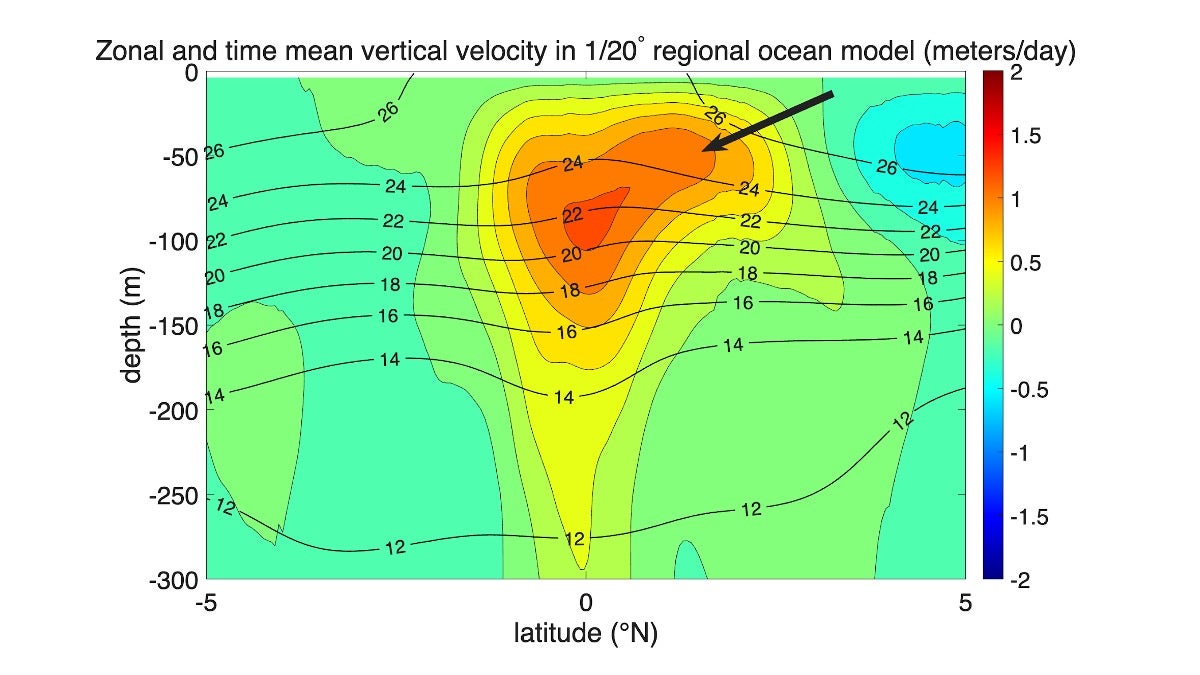
Vertical velocity (color) and temperature (black contours every 2°C) as a function of depth and latitude in a 1/20°-resolution regional ocean simulation of the east-central equatorial Pacific. The fields are averaged over 1999–2018 and 95°W–170°W. The arrow highlights the eddy-driven northward extension of upwelling.
Importantly, this newly isolated eddy-driven circulation also resolves an observational puzzle: why the mean meridional divergence of surface currents measured over decades by satellite-tracked drifters is stronger to the north of the equator than to the south. By linking this meridional asymmetry in both divergence and upwelling to eddy activity, the study identifies a key process that is crudely represented in global climate models and may be linked to their longstanding biases.
The implications are significant. Equatorial upwelling plays a central role in regulating global climate, influencing phenomena such as El Niño, air–sea heat and carbon exchange, and nutrient supply to the upper ocean and marine ecosystems. Given that eddies substantially regulate the upwelling pattern, accurately observing and modeling equatorial eddies and their rectified effects is essential for climate prediction. This work underscores a broader message: small-scale ocean processes can have regional and global climate impacts. Improving how these processes are observed and modeled is essential for improving predictions of climate variability and change.
Whitt, D. B., F. O. Bryan, W. Kessler, L. Thompson, and A. Deppenmeier, 2026: Eddies drive meridionally asymmetric upwelling in the Equatorial Pacific. J. Phys. Oceanogr., 56, 599–626, https://doi.org/10.1175/JPO-D-25-0126.1.
Topics
- Air-Sea
- Carbon
- ENSO
- Pacific Ocean