
Enhanced Upper-Ocean Horizontal Advection in a High-Resolution Climate Models Improves the Representation of High-Frequency Near-Surface Temperature Variability
Chaehyeong
Lee
University of Colorado Boulder
Poster
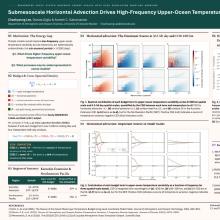
The recent trend toward longer-lasting near-surface temperature anomalies is closely tied to high frequency upper ocean dynamics. While low-frequency variance remains consistent with observations regardless of model resolution, many climate models (e.g., CESM-LR, GFDL-CM4) fail to accurately represent high-frequency upper-ocean temperature variance, consistently underestimating it in the sub-seasonal band (<O(100) days). We investigate the dynamical causes behind this failure by comparing the sea surface temperature (SST) variability between a high spatial resolution climate model (CESM-HR) and a lower-resolution counterpart (CESM-LR), evaluating both against satellite observations. We find that fine spatial resolution enhances the representation of SST variability in most regions. Specifically, CESM-HR closes the variance gap in the high-frequency SST signal compared to observations, which mitigates the overestimation of upper-ocean thermal memory seen in coarser models. In CESM-HR, upper-ocean horizontal temperature advection is more energetic and acts as the primary contributor to this high-frequency SST variance. These results highlight the critical importance of resolving small-scale features, such as mesoscale eddies, to accurately represent upper-ocean temperature variability, with implications for long-term projections of the global ocean state. Furthermore, our study suggests that thermal memory, which integrates this SST variability, could serve as a robust metric for evaluating the performance of future climate models.
Poster file
chaehyeong-lee-highres.pdf
(5.04 MB)