
Probing the Impact of Model Resolution on Subseasonal Predictability with Higher-Order Linear Inverse Modeling
Raphaël
Hébert
University of Wisconsin-Milwaukee
Poster
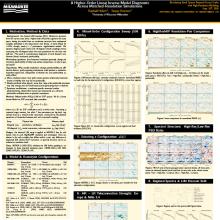
Skillful prediction of near-surface temperature at daily to subseasonal timescales remains one of the outstanding challenges in atmospheric science. A key open question in the context of high-resolution climate modeling is whether increased spatial resolution genuinely enhances the inherent stochastic predictability of the atmospheric state, or primarily refines spatial detail without affecting predictability limits.
To address this, we use a higher-order AR(p) Linear Inverse Model (LIM) in EOF space as a diagnostic framework. By fitting the same model to different datasets and comparing the resulting skill, we characterize the predictability encoded in the correlation structure of each simulation. The LIM combines a mixed-order lag structure with a coherency-based sparsity mask to regularize the parameter space, and is first validated against MERRA-2 reanalysis over 1980 to 2021.
We then apply this framework to daily near-surface temperature fields from three HighResMIP model pairs: CESM, CNRM-CM6-1, and MPI-ESM1-2, spanning the same period under identical external forcing. This controlled pairing, where resolution is the only variable changed, allows us to directly attribute differences in diagnosed predictability to resolution effects.
We address three specific questions. Does horizontal resolution affect the inherent stochastic predictability of the simulated temperature fields at subseasonal timescales, as measured by skill scores in physical space? Does it influence the optimal EOF truncation, with higher resolution either introducing additional predictable modes or primarily adding noise? And does resolution shape the power spectral structure of temperature variability, translating into differences in the characteristic timescales of temporal autocorrelation?
To address this, we use a higher-order AR(p) Linear Inverse Model (LIM) in EOF space as a diagnostic framework. By fitting the same model to different datasets and comparing the resulting skill, we characterize the predictability encoded in the correlation structure of each simulation. The LIM combines a mixed-order lag structure with a coherency-based sparsity mask to regularize the parameter space, and is first validated against MERRA-2 reanalysis over 1980 to 2021.
We then apply this framework to daily near-surface temperature fields from three HighResMIP model pairs: CESM, CNRM-CM6-1, and MPI-ESM1-2, spanning the same period under identical external forcing. This controlled pairing, where resolution is the only variable changed, allows us to directly attribute differences in diagnosed predictability to resolution effects.
We address three specific questions. Does horizontal resolution affect the inherent stochastic predictability of the simulated temperature fields at subseasonal timescales, as measured by skill scores in physical space? Does it influence the optimal EOF truncation, with higher resolution either introducing additional predictable modes or primarily adding noise? And does resolution shape the power spectral structure of temperature variability, translating into differences in the characteristic timescales of temporal autocorrelation?
Poster file
raphael-hebert-highres.pdf
(3.26 MB)