
PepC-Global: A Basin-Tuned, Environment-Dependent Probabilistic Tropical Cyclone Model
Cong
Gao
Poster
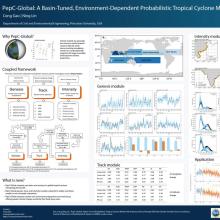
The Princeton environment-dependent probabilistic tropical cyclone model (PepC), initially developed by Jing and Lin (2020), generates synthetic tropical cyclones (TCs) for probabilistic risk assessment in the North Atlantic. The original PepC framework includes three components: a hierarchical Poisson genesis model, an analog-wind track model, and a Markov intensity model. Here, we present PepC-Global, an enhanced and basin-tuned extension of PepC for major TC basins, including the western North Pacific, eastern North Pacific, North Indian Ocean, South Indian Ocean, Australian region, and South Pacific.
PepC-Global improves the original framework in several ways. For genesis, it replaces the linear model in the hierarchical Poisson framework with support vector regression, improving the representation of temporal variability and spatial genesis patterns. For tracks, the analog-wind model is complemented by a pure-wind track model, which is more sensitive to environmental steering flow and does not rely on prior track information. For intensity, the Markov Environment-Dependent Hurricane Intensity Model (MeHiM) is extended beyond the North Atlantic and shows strong performance in predicting intensity change, lifetime maximum intensity, and landfall intensity across multiple basins.
Compared with other global TC risk models, such as the Emanuel statistical-deterministic model and the Columbia Hazard model (CHAZ), PepC-Global combines a global framework with basin-specific tuning. This design allows it to better capture regional differences in climatology, environmental conditions, and TC behavior. Validation against historical TC records shows improved performance in simulating annual frequency, genesis distributions, track variability, and intensity evolution. Comparisons between basin-tuned and non-basin-tuned simulations further demonstrate that basin-specific calibration substantially improves the representation of regional TC characteristics, making PepC-Global a useful tool for global probabilistic TC risk assessment.
PepC-Global improves the original framework in several ways. For genesis, it replaces the linear model in the hierarchical Poisson framework with support vector regression, improving the representation of temporal variability and spatial genesis patterns. For tracks, the analog-wind model is complemented by a pure-wind track model, which is more sensitive to environmental steering flow and does not rely on prior track information. For intensity, the Markov Environment-Dependent Hurricane Intensity Model (MeHiM) is extended beyond the North Atlantic and shows strong performance in predicting intensity change, lifetime maximum intensity, and landfall intensity across multiple basins.
Compared with other global TC risk models, such as the Emanuel statistical-deterministic model and the Columbia Hazard model (CHAZ), PepC-Global combines a global framework with basin-specific tuning. This design allows it to better capture regional differences in climatology, environmental conditions, and TC behavior. Validation against historical TC records shows improved performance in simulating annual frequency, genesis distributions, track variability, and intensity evolution. Comparisons between basin-tuned and non-basin-tuned simulations further demonstrate that basin-specific calibration substantially improves the representation of regional TC characteristics, making PepC-Global a useful tool for global probabilistic TC risk assessment.
Poster file
gao-cong-highres.pdf
(10.09 MB)