
The response of extratropical cyclone-induced moisture fluxes to climate change in high-resolution simulations and their impact on extreme wet and dry seasons
Dalila
Mäder Arrabali
Institute for Atmospheric and Climate Science, Department of Environmental Systems Science, ETH Zurich
Poster
"Extratropical cyclones (ETCs) play a pivotal role in hydrological processes of the atmosphere, such as evaporation, moisture transport and precipitation. Long-term changes in the hydrological-cycle contribution of ETCs will therefore have important impacts on precipitation patterns, droughts, and extreme events. ETCs over the North Atlantic are projected to decrease in frequency and increase in intensity under global warming – maintaining a near balance in their net contribution to moisture fluxes. However, hydrological cycle changes associated with smaller scale processes embedded within ETCs may exhibit stronger signals and are more uncertain, because they are under-resolved in conventional climate model simulations. Assessing how ETC-related moisture fluxes and their response to climate change vary with resolution is therefore essential both for improved process understanding and for improved predictions of future changes in moisture transport and extreme hydrological events.
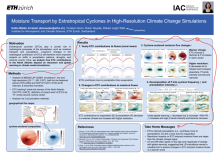
In this study, we investigate how North Atlantic ETC-induced moisture fluxes respond to global warming in high-resolution simulations. We analyze long-term historical and RCP-8.5 simulations from the MESACLIP project based on high-resolution CESM1.3 (0.25° in the atmosphere and 0.1° in the ocean) and compare them with corresponding simulations with 1° atmosphere and ocean resolution. Using cyclone tracking algorithms, we quantify long-term changes in ETC-induced moisture fluxes and compare results across model resolutions. We find that ETC contributions to both evaporation and precipitation significantly increase with higher resolution, and that this effect is even larger than the change from the historical to the strong warming scenario at a given resolution. We also analyze the drivers of these changes, focussing on changes in cyclone frequency, precipitation intensity, sea surface temperature and sea level pressure anomalies. Finally, we examine how these changes in ETC-induced moisture fluxes impact extreme dry and wet seasons over Western Europe."
In this study, we investigate how North Atlantic ETC-induced moisture fluxes respond to global warming in high-resolution simulations. We analyze long-term historical and RCP-8.5 simulations from the MESACLIP project based on high-resolution CESM1.3 (0.25° in the atmosphere and 0.1° in the ocean) and compare them with corresponding simulations with 1° atmosphere and ocean resolution. Using cyclone tracking algorithms, we quantify long-term changes in ETC-induced moisture fluxes and compare results across model resolutions. We find that ETC contributions to both evaporation and precipitation significantly increase with higher resolution, and that this effect is even larger than the change from the historical to the strong warming scenario at a given resolution. We also analyze the drivers of these changes, focussing on changes in cyclone frequency, precipitation intensity, sea surface temperature and sea level pressure anomalies. Finally, we examine how these changes in ETC-induced moisture fluxes impact extreme dry and wet seasons over Western Europe."
Poster file
MäderArrabali-Dalila-hires.pdf
(1.02 MB)