
Role of improved Diffusivity Parameterization on Heat Content Simulations in the Tropical Indian Ocean Using Ocean General Circulation Model
Soma
Mishra
Project Scientist 1
Poster
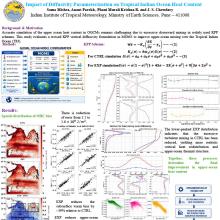
Accurate simulation of the spatial and temporal variability of Oceanic Heat Content (OHC) by the ocean general circulation models (OGCM) is a fundamental prerequisite for understanding the climate variability. A major limitation of OGCM and climate models lies in their representation of upper-ocean vertical mixing, which is parameterised by K-Profile Parameterization (KPP) scheme. Control (CTRL) simulations using the Modular Ocean Model version 5 (MOM5), forced with JRA55-do for 2009–2023, with default KPP is carried out. Analysis of subsurface temperature exhibit pronounced OHC biases relative to EN4 and ARGO observations over the Tropical Indian Ocean (TIO). However, the modified KPP experiment yields reduction in the subsurface temperature bias, which leads to realistic representation of OHC, reduction of bias by around 30%. Modified diffusivity profile through shape function includes mixing parameterisation of nonbreaking waves in KPP, which reduces excessive mixing and improved representation of vertical turbulent kinematic heat fluxes, stratification, and shear. These findings underscore the importance of refining upper-ocean mixing parameterizations to achieve more realistic simulations of OHC in climate models and to reduce long-standing warm biases in OGCMs. These results demonstrate that refining upper-ocean mixing parameterizations is critical for reducing long-standing warm biases and improving OHC fidelity in climate models.
Poster file
diffusivity_parameterization_soma_mishra.pdf
(522.86 KB)