
Research Highlights
We aim to feature the latest research results from US scientists whose published paper features work that is sponsored by one or more sponsoring agency programs of US CLIVAR (NASA, NOAA, NSF, DOE, ONR). Check out the collection of research highlights below and sort by topic on the right. Interested in submitting an article for consideration? See our Research Highlight Submission Guidelines page for more information.
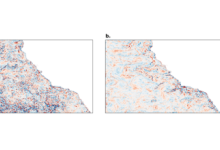
Gazeley et al. (2026) examine upper-ocean stratification in the California Current from March to October 2023. Researchers find that small, rapidly rotating eddies dominate in winter, while larger, smoother eddies prevail in the summer. This shows that unresolved submesoscale motions influence mesoscale variability and ocean predictability. Most climate and forecast models, however, are too coarse to resolve these features.
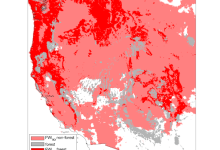
Fire weather – a combination of wind, humidity, and fuel receptivity is an important ingredient in fire outcomes and the ability of local fire suppression activities to contain a fire. While studies have demonstrated strong links between both daily and interannual variability in fire weather conditions and fire activity, this study explores links between spatially compound extremes in fire weather, national fire suppression resource strain, and burned area across forests of the western US.
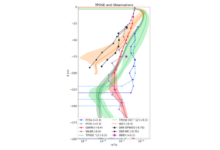
Davenport et al. (2026) use the Tropical Pacific Ocean State Estimate (TPOSE) to investigate the role of internal gravity waves in closing the Cold Tongue momentum budget. The authors conclude that accurate simulation of Cold Tongue SST may require separate representation of turbulent and wave-driven momentum transport, informed by targeted observations and wave-resolving models.
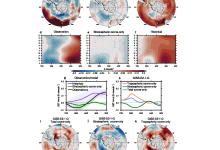
Li et al. (2026) quantified the transient influence of stratospheric ozone depletion on Southern Ocean sea surface temperature (SST) changes during 1982–2005 using coupled climate model simulations from CMIP5 and CMIP6 combined with observational datasets. By applying stratospheric ozone-only simulations, they isolated the SST response attributable to ozone depletion while excluding other external forcing factors.
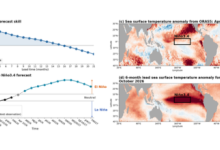
Wang et al. (2026) present the Wyrtki CycloStationary Linear Inverse Model (Wyrtki-CSLIM), which leverages Wyrtki and Hasselmann memory to demonstrate that skillful ENSO forecasts can be generated up to 15 months in advance using a relatively simple framework based on sea surface temperature and sea level observations.